1000 Creative Prompts of Science
What if gravity reversed for exactly 9.3 seconds every Tuesday? What if human memory could be edited like a video file—and shared across devices? What if photosynthesis evolved in animals instead of plants? These aren’t just whimsical questions—they’re entry points. 1000 Creative Prompts of Science turns scientific literacy into imaginative fuel, offering over 1,000 rigorously grounded “what if” scenarios across 20 disciplines—from neuroscience and synthetic biology to quantum computing and exoplanet geology.
This isn’t a textbook or a trivia deck. It’s a working toolkit: a curated bridge between factual understanding and original thinking. Each prompt is designed to be precise enough to spark real inquiry, open-ended enough to invite interpretation, and diverse enough to serve creators who think in code, classrooms that value critical discussion, and marketers building science-forward campaigns.
Why These Prompts Work Where Others Don’t
Most idea generators fall into one of two traps: too vague (“Imagine the future!”) or too narrow (“List five uses for graphene”). 1000 Creative Prompts of Science avoids both by anchoring imagination in real scientific frameworks. A prompt like “What if CRISPR could target epigenetic markers across generations—but only in response to ambient sound frequencies?” invites exploration of gene editing, inheritance, acoustics, and ethics—all at once.
The structure supports depth without demanding expertise. You don’t need a PhD to use it—just curiosity and the willingness to ask “Then what?” three times. That makes it uniquely effective for interdisciplinary work: a designer prototyping bio-integrated wearables, a podcaster scripting an episode on AI bias, or a high school teacher framing a debate on neuroethics.
Real-World Uses Across Audiences
For educators: Use prompts as low-stakes warm-ups or project launchers. Assign “What if Earth had two suns with different spectral classes?” and let students research stellar physics, climate modeling, and evolutionary adaptation—then present findings as speculative infographics or short documentaries. The included themed visuals help scaffold learning without oversimplifying.
For writers and content creators: These prompts function like creative sparring partners. Instead of starting from blank-page anxiety, you begin with a constraint that carries built-in tension and logic. Try pairing a prompt with a format: turn “What if dark matter interacted weakly with human neural tissue?” into a 500-word microfiction piece, a LinkedIn carousel on emerging neurotech risks, or a script outline for a limited-series thriller.
For entrepreneurs and product teams: Treat prompts as innovation sprints. Run a 45-minute session where each team member picks one prompt related to their domain—e.g., robotics, materials science, behavioral economics—and sketches one viable application, one ethical red flag, and one unexpected user group. You’ll surface ideas faster than traditional brainstorming because the prompts already encode complexity and consequence.
For designers and visual communicators: The editable Canva link isn’t just convenient—it’s strategic. Swap color palettes to match brand guidelines, adjust typography for accessibility, or reframe a prompt as a poster, social tile, or workshop handout. The 6×9 inch, bleed-free, 300 DPI PDFs mean your printed zine, conference handout, or classroom wall chart retains clarity and impact.
How to Stay Focused Without Losing Spark
Creativity thrives on boundaries—not just freedom. To keep output clear and audience-friendly, apply these practical filters when using a prompt:
- Define your goal first. Are you generating story hooks? Teaching a concept? Validating a product assumption? Choose prompts aligned with intent—not just the flashiest ones.
- Anchor in one discipline before expanding. Start with the core science (e.g., thermodynamics in a prompt about perpetual motion), then layer in adjacent fields (materials engineering, energy policy) only as needed.
- Test for clarity, not cleverness. If explaining the prompt to someone unfamiliar with the field takes more than 20 seconds, simplify the language—not the idea.
- Document your assumptions. Every “what if” rests on unstated premises. Note them. They’re often where your most original insights live.
More Than a Prompt List—It’s a Design System for Thinking
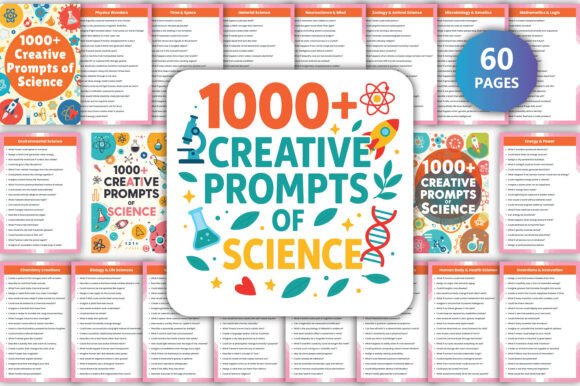
The collection’s strength lies in its consistency and flexibility. All 60 pages follow a clean, illustrated format: each prompt appears with space for notes, a subtle icon indicating its primary discipline (e.g., 🧫 for microbiology, 🌐 for network theory), and optional cross-references to related concepts. This isn’t decorative—it’s functional scaffolding. When you return to a prompt weeks later, the visual cue instantly recalls context. When you share a page with a collaborator, the structure communicates intent without extra explanation.
And because the files include JPGs, PDFs, and an editable Canva link, you’re never locked into one output mode. Repurpose a single prompt across platforms: drop the text into a Notion database for long-term idea tracking, convert the image into an Instagram Story slide, print a batch as physical cards for in-person workshops, or embed the PDF into a course LMS.
Getting Started—No Setup Required
You don’t need to read all 1,000 prompts to benefit. Start small:
- Pick one branch you know well—and one you don’t (e.g., chemistry + astrophysics).
- Scan three prompts from each. Circle the one that makes you pause—even briefly.
- Spend 7 minutes writing down everything it makes you wonder, question, or connect to.
- Review. Is there a thread you can follow further? A problem it reframes? A conversation it could start?
That’s how inspiration becomes action. Not through grand declarations, but through deliberate, repeatable engagement—with science, with possibility, and with your own capacity to reinterpret what’s known.
1000 Creative Prompts of Science doesn’t promise breakthroughs. It offers something more reliable: a disciplined way to practice the kind of thinking that leads to them.