The Science of Light Workbook
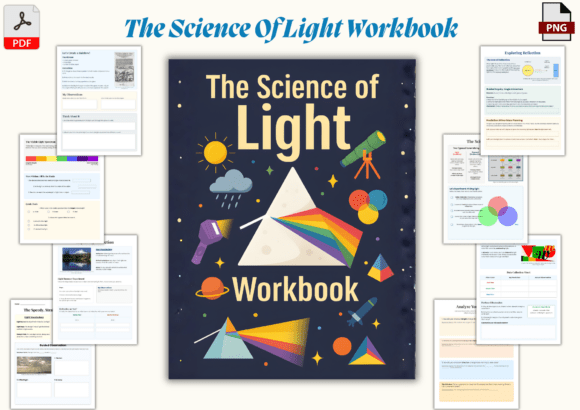
If you’ve ever watched a child tilt a prism toward sunlight and gasp as rainbows spill across the wall—or seen a homeschooler sketch shadow shapes at different times of day—you know light isn’t just a physics topic. It’s wonder made visible. The Science of Light Workbook turns that wonder into structured, joyful learning. Designed for Grades 3–7 but widely used by educators, curriculum designers, and curious adults exploring foundational optics, this 8.5 x 11-inch PDF/PNG resource blends inquiry-based science with tactile engagement: mirror maze design, prism investigations, color mixing experiments, and shadow art challenges—all anchored in real observation, prediction, and reflection.
Yet many buyers—especially those new to hands-on science resources—overlook subtle but critical details that affect how well The Science of Light Workbook delivers on its promise. Not because the workbook falls short, but because expectations, setup, and usage habits often misalign with its intentional design.
Assuming “Printable” Means “Plug-and-Play”
A common first misstep? Treating the PDF like a static worksheet packet. The Science of Light Workbook is interactive by design—not just in layout, but in pedagogy. Pages include blank data tables for refraction trials, dotted lines for folding mirror-angle diagrams, and shaded zones for sketching predicted vs. observed shadow paths. If you print it single-sided without checking printer settings (e.g., “fit to page” scaling), diagrams shrink, margins collapse, and measurement prompts become unusable. One teacher reported students struggling to trace mirror angles because the printed version reduced a 4-inch protractor diagram to 2.7 inches—distorting angle estimation.
Better approach: Before printing, open the file in Adobe Acrobat (not a browser PDF viewer) and select “Actual Size” under Page Scaling. Print a test page—especially the prism investigation chart or mirror maze grid—and hold it next to a ruler. If measurements don’t match, adjust your printer’s default scaling. For digital use, the PNG version works smoothly in annotation apps like GoodNotes or OneNote—ideal for remote learners or flipped classrooms.
Misreading the Audience Scope
While labeled for Grades 3–7, some users assume it’s *only* for children—or conversely, that it’s too basic for older learners. In reality, its layered scaffolding supports differentiation: younger students focus on observation and drawing; upper-grade learners extend into variables (e.g., “How does distance from light source affect shadow sharpness?”) and qualitative analysis. A homeschool parent found her 11-year-old revisiting the color mixing section—not just blending paints, but comparing additive (light) vs. subtractive (pigment) models using the included Venn diagram—and then designing a simple LED-based color wheel.
What to check before buying: Scan the table of contents for verbs—not just topics. Phrases like “predict and record,” “design a test,” or “revise your hypothesis” signal higher-order thinking. If your goal is rote memorization of the visible spectrum, this workbook may feel slow. But if you value building scientific reasoning—not just facts—it’s precisely calibrated.
Overlooking Material Requirements (and Underestimating Simplicity)
The workbook lists common household items: flashlights, white paper, clear glass prisms, small mirrors, colored cellophane. Some users delay starting, waiting for “perfect” materials—like a calibrated optical prism—when a clean glass paperweight or even a water-filled fishbowl demonstrates refraction beautifully. Others skip the shadow art challenge entirely, assuming it needs a sunny south-facing window, when a desk lamp + cardboard cutout yields equally rich data on umbra/penumbra.
Conversely, skipping material prep altogether causes friction. One science enrichment program distributed the workbook without pre-testing the mirror maze activity—only to discover their plastic craft mirrors produced faint, distorted reflections, making angle tracing nearly impossible. Switching to first-surface mirrors (or even aluminum foil taped smoothly over cardboard) resolved it instantly.
Practical tip: Do a 10-minute “kit check” before lesson planning. You likely already own 80% of what’s needed. For prisms, try a crystal pendant or a triangular glass paperweight. For controlled light, use a smartphone flashlight app with brightness locked. The goal isn’t lab-grade precision—it’s consistent, observable phenomena.
Underutilizing the Reflection Prompts
The workbook includes dedicated spaces for written reflection after each major activity—“What surprised you?”, “How did your prediction compare?”, “What would you test next?” These aren’t busywork. They’re cognitive anchors. Yet many users treat them as optional, especially in time-pressed classrooms or solo study sessions. Without pausing to articulate reasoning, students miss the chance to solidify cause-effect thinking—like why red light bends less than violet in a prism (shorter wavelength = greater refraction).
Better practice: Use reflection prompts as low-stakes formative assessment. In group settings, have students share one sentence aloud before writing. For independent learners, set a timer: 90 seconds to jot down *one* genuine question sparked by the experiment. That habit builds metacognition—the skill of thinking about how we think—far more than any multiple-choice quiz.
Confusing “Digital File” With “Self-Contained Experience”
Because The Science of Light Workbook is delivered as a digital file, some assume no supplemental support is needed. But its strength lies in integration—not isolation. The prism experiments reference real-time observation; the reflection section assumes access to adjustable light sources; the visible spectrum pages invite comparison with natural rainbows or LED displays. Without contextual framing—whether from a teacher’s quick demo, a 2-minute video clip, or even a shared photo of a sunset’s color gradient—the concepts can feel abstract.
Solution: Pair each major section with one concrete anchor: show a slow-motion video of light bending in water before the refraction lab; display a high-res image of Newton’s original prism experiment alongside the workbook’s diagram; or use a free online spectroscope simulator to compare wavelengths interactively. These take minutes—but transform pages into portals.
In short, The Science of Light Workbook works best not as a standalone product, but as a well-prepared catalyst. Its clarity comes from structure, not simplification. Its engagement emerges from intention—not gimmicks. When matched with thoughtful setup, realistic material expectations, and space for reflection, it doesn’t just teach light. It teaches how to see the world—and question it—more deeply.