ADHD Mindflow Method: A Gentle, Science-Informed Path to Focus and Calm
If your mind feels like a browser with 47 tabs open—some playing music, others loading slowly, a few crashed, and one mysteriously titled “???”—you’re not broken. You’re neurodivergent. And the ADHD Mindflow Method isn’t about fixing you. It’s about meeting your brain where it is—with kindness, structure, and intention—and helping it flow with less friction.
This isn’t another rigid productivity system built for linear thinkers. It’s a printable, mindfulness-infused workbook designed specifically for fast-moving, creative, easily overwhelmed ADHD minds. Backed by principles from cognitive behavioral therapy (CBT), executive function coaching, and attention science, the ADHD Mindflow Method bridges the gap between emotional regulation and practical action—without demanding perfection, willpower, or hours of prep time.
Why “Structure” Doesn’t Have to Feel Like a Straitjacket
A common misconception about ADHD support tools is that they must be strict, rule-heavy, or time-bound. In reality, many people with ADHD don’t resist structure—they resist ineffective structure. Rigid planners that assume consistent energy, flawless memory, or uninterrupted focus often deepen shame and avoidance.
The ADHD Mindflow Method flips that script. Its structure is gentle, modular, and self-guiding. Think of it like training wheels—not to limit movement, but to build confidence while learning balance. Each tool invites participation, not compliance. You choose what resonates today, not what “should” work based on someone else’s neurotype.
The 4-Step Focus System: From Mental Clutter to Intentional Action
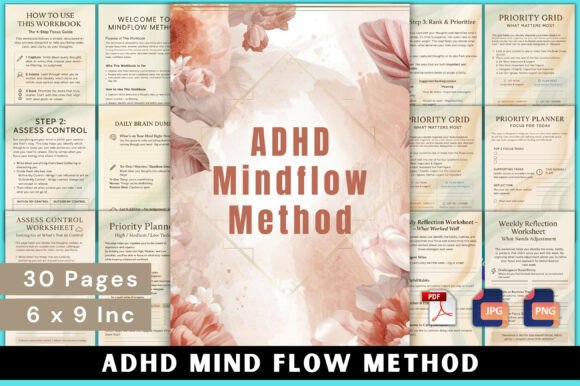
At its core lies the 4-Step Focus System: Capture → Assess → Rank → Execute. This sequence mirrors how the ADHD brain naturally seeks clarity—but adds just enough scaffolding to prevent looping, impulsivity, or decision paralysis.
- Capture: No filtering, no editing—just brain dumping onto a dedicated page. That half-formed idea at 3 a.m.? The grocery list + existential question about career purpose? Jot it all down. This step honors your mind’s associative nature while preventing mental hoarding.
- Assess: Ask two simple questions: “Is this mine to carry?” and “Does this align with my current values or goals?” This builds metacognitive awareness—the ability to observe your thoughts without being swept away by them.
- Rank: Use intuitive visual grids (not abstract priority matrices) to sort tasks by energy required, urgency, and personal meaning. This respects fluctuating executive function—not every day demands high-focus work, and that’s okay.
- Execute: Not “do everything,” but “choose one next step.” The daily execution planner breaks intentions into micro-actions (“Open document,” “Write first sentence,” “Set timer for 8 minutes”)—reducing activation energy and honoring working memory limits.
More Than Planning: Emotional Regulation Built Into Every Page
For many with ADHD, overwhelm isn’t just logistical—it’s physiological. Racing thoughts trigger nervous system dysregulation: shallow breathing, restlessness, emotional reactivity. That’s why the ADHD Mindflow Method integrates emotional regulation directly into task management.
The “Assess Control” worksheet, for example, gently guides users to separate “Circle of Control” items (e.g., my response, my preparation, my self-compassion) from “Circle of Concern” items (e.g., traffic delays, others’ moods, weather). This isn’t toxic positivity—it’s cognitive reframing rooted in Stoic philosophy and modern ACT (Acceptance and Commitment Therapy). Over time, users report lower anxiety and increased agency—even when external circumstances remain unchanged.
Daily Reflection: Not Just “What Did I Do?” But “How Did I Feel While Doing It?”
Traditional habit trackers ask, “Did I do it?” The ADHD Mindflow Method asks, “What supported me?” and “When did my focus feel effortless—and why?”
Daily and weekly reflection pages invite curiosity, not judgment. Users note small wins (“Sent that email without rereading 12 times”), energy patterns (“Felt sharpest after morning walk”), and environmental triggers (“Got derailed when phone buzzed during deep work”). This cultivates self-knowledge—the most powerful tool for sustainable change.
Real-Life Applications: Work, Creativity, Parenting, and Beyond
This method isn’t confined to solo journaling. Its flexibility makes it relevant across life domains:
- In hybrid workplaces: Use the Brain Dump pages before meetings to clear mental static; apply the 4-Step System to break complex projects into “next physical actions” instead of vague “figure it out” goals.
- For creatives and entrepreneurs: Capture scattered inspiration without losing momentum—then use ranking grids to identify which idea has both spark and feasibility right now.
- In parenting with ADHD: Model emotional regulation by naming your own “Assess Control” moments aloud (“I can’t make the toddler eat broccoli, but I can offer two fun choices”). Co-create simplified versions of reflection pages with kids to build shared awareness.
- In academic settings: Students use Priority Goal Planning Tools to chunk research papers or study sessions—pairing each step with a grounding technique (e.g., “Breathe in for 4, hold for 4, exhale for 6”) to reset attention.
My Coping Toolbox: Personalized, Practical, and Always Accessible
One standout feature is the “My Coping Toolbox” section—a customizable, printable reference of what truly works for you. Unlike generic lists (“try meditation!”), this invites users to record evidence-based strategies they’ve tested: “5-minute dance break resets my focus,” “Chewing gum helps me listen in meetings,” “Texting my accountability buddy before scrolling reduces guilt.”
This combats the “tool fatigue” many experience—trying dozens of hacks without retention. Here, effectiveness is measured not by popularity, but by personal resonance and repeat use.
Debunking Myths: What the ADHD Mindflow Method Is *Not*
Before diving in, let’s clarify what this approach doesn’t promise:
- It’s not a cure. ADHD is a lifelong neurodevelopmental variation—not a deficit to eliminate. This method supports thriving with ADHD, not erasing it.
- It doesn’t require daily perfection. Missed days? Skipped reflections? That’s data—not failure. The workbook includes gentle prompts like “What made today different?” to foster insight, not shame.
- It’s not only for “high-functioning” individuals. Designed with accessibility in mind, it offers low-literacy options, visual cues, and minimal writing requirements—making it usable during low-energy or dysphoric periods.
- It’s not a replacement for clinical care. While supportive, it complements—not substitutes—therapy, medication, or accommodations recommended by qualified professionals.
Your Journey, Celebrated—Not Just Completed
Every meaningful shift begins with showing up for yourself, again and again. That’s why the ADHD Mindflow Method ends with the Certificate of Clarity: a printable milestone marker acknowledging growth in self-awareness, consistency, and compassion—not just output.
Clarity isn’t the absence of chaos. It’s the ability to recognize your inner weather—and choose your response. With the ADHD Mindflow Method, you’re not building a quieter mind. You’re building a wiser relationship with the brilliant, dynamic, beautifully unpredictable mind you already have.
Ready to begin? Start with one Brain Dump page. No agenda. No deadline. Just presence—and the quiet permission to let your mind breathe.