Why the 💖 2026 ADHD Template for Women Is Changing How Women With ADHD Plan, Prioritize, and Thrive
For years, women with ADHD have searched for planners that don’t just ask them to “try harder” — but actually meet their brains where they are. Generic productivity tools often backfire: too rigid, too cluttered, too silent on emotional overwhelm or executive dysfunction spikes midday. That’s why the 💖 2026 ADHD Template for Women stands out — not as another pretty PDF, but as a thoughtfully engineered support system built from lived experience, clinical insight, and real-world trial.
A Planner Designed *With* the ADHD Brain — Not Against It
This isn’t a repackaged bullet journal or a corporate calendar adapted for neurodivergent users. The 💖 2026 ADHD Template for Women was created by someone who understands how memory retrieval falters under stress, how time blindness distorts planning, and how emotional regulation is inseparable from task completion. Every page reflects that awareness.
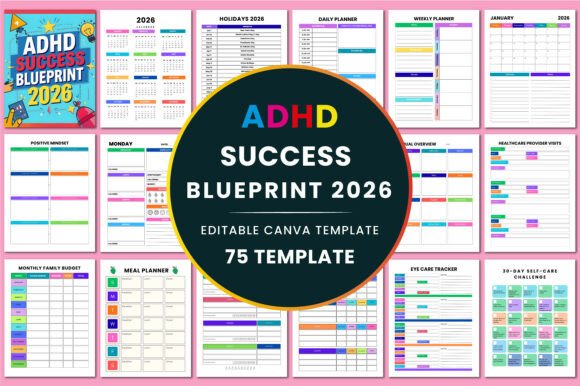
Take the Daily Focus Sheets: instead of blank lines begging for discipline, they include gentle self-care checklists right alongside priority tasks — because for many women with ADHD, skipping lunch or skipping hydration doesn’t just lower energy — it directly impairs working memory and impulse control. Or consider the Brain Dump Task Sorting Pages: they don’t assume you’ll know what to do with your swirling thoughts. They guide you through categorizing, triaging, and assigning next actions — all in one glance-friendly layout.
Flexibility Built In — Not an Afterthought
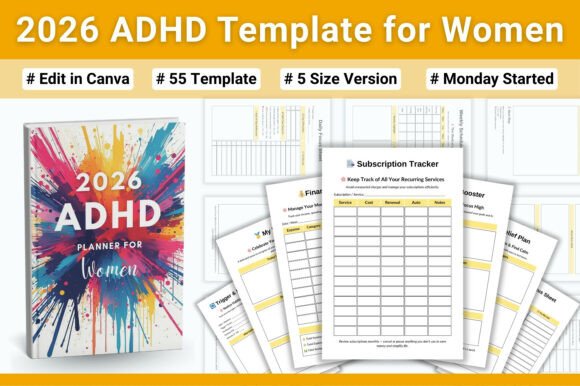
One size does not fit all — especially when it comes to neurodivergent planning. That’s why the 💖 2026 ADHD Template for Women comes in five practical formats: US Letter, A4, A5, 6x9 (Half US Letter), and compact A5. Whether you prefer a desk-bound A4 spread, a portable A5 notebook, or something you can slip into a small bag — it adapts to your rhythm, not the other way around.
And because life rarely starts on January 1st, every page is undated. Start using it the day you download it — whether that’s March 17th, August 2nd, or November 30th. No guilt. No wasted pages. Just immediate, relevant support.
More Than Scheduling — It’s Emotional Infrastructure
ADHD in women often presents with high masking, chronic self-doubt, and emotional exhaustion that builds silently over years. That’s why this planner goes beyond calendars and to-do lists. It includes:
- Morning & Evening Routine Builders — not prescriptive scripts, but customizable scaffolds that help anchor transitions between states of being;
- Weekly Schedule Pomodoro Trackers — pairing time-blocking with built-in rest intervals, honoring attention span limits without demanding perfection;
- Goal Breakdown Templates — breaking big intentions into micro-steps with visual progress cues, reducing the paralysis that comes with vague ambitions like “get organized” or “feel better.”
These aren’t add-ons. They’re integrated features — because regulating emotion and managing tasks aren’t separate skills for the ADHD brain. They’re interwoven. Ignoring one undermines the other.
Real-Life Use Cases: Where This Planner Fits In
You don’t need to be “in crisis” to benefit from the 💖 2026 ADHD Template for Women — but if you’ve ever felt exhausted just thinking about your calendar, this is your reset button.
Scenario 1: The Working Mom
Juggling remote work, school logistics, therapy appointments, and household upkeep? She uses the Weekly Focus Planners to assign one theme per day — “Admin Day,” “Connection Day,” “Reset Day” — rather than fighting constant context-switching. Her Time Blocking Templates include buffer zones before and after meetings, because she knows her brain needs ramp-up and decompression time.
Scenario 2: The Creative Freelancer
Her deadlines shift. Her energy surges unpredictably. She leans into the Brain Dump Pages at the start of each week, then uses the Task Sorting Grid to identify which items are urgent, which are emotionally charged, and which can wait until her focus window opens. She prints only the pages she needs — no wasted paper, no visual noise.
Scenario 3: The Newly Diagnosed Woman in Her 30s
Still untangling decades of misattributed “laziness” or “disorganization”? She starts with the Morning Routine Builder, testing small anchors — one glass of water, five minutes outside, naming one feeling — before layering in more structure. The planner meets her where she is, not where she thinks she “should” be.
Digital-Friendly, Print-Ready, and Thoughtfully Designed
The 💖 2026 ADHD Template for Women isn’t just printable — it’s optimized for both digital and physical use. Crisp 300 DPI resolution ensures clean lines whether you’re printing at home or sending to a local print shop. Light gray guides and ample white space reduce visual fatigue. Fonts are legible, headings are scannable, and checkboxes are generously sized — because fine motor challenges or screen glare shouldn’t block access to your own planning.
It’s also designed to scale: print single pages as needed, bind into a custom notebook, or use in a digital note-taking app with stylus support. Many users pair it with GoodNotes or Notability — tapping into handwriting benefits while keeping backups secure.
What Makes This Different From Other ADHD Planners?
Plenty of planners claim to be “ADHD-friendly.” But few embed neurodivergent wisdom so consistently across 55 pages. Here’s what sets the 💖 2026 ADHD Template for Women apart:
- No toxic positivity — affirmations are grounded, not generic (“I am learning to trust my rhythm” vs. “I am unstoppable”);
- No assumption of linear progress — weekly reviews include prompts like “What surprised me this week?” and “Where did I protect my energy?”;
- No hidden gender bias — routines acknowledge caregiving labor, hormonal shifts, and social expectations that disproportionately impact women with ADHD;
- No one-size-fits-all tracking — mood, energy, focus, and sensory load are tracked separately, because they don’t always move in sync.
Practical Tips Before You Begin
If you’re new to using a specialized planner like the 💖 2026 ADHD Template for Women, start small:
- Don’t print everything at once. Try just the Daily Focus Sheet and Morning Routine Builder for three days. Notice what feels supportive — and what feels like extra work.
- Give yourself permission to abandon pages. If a tracker isn’t clarifying anything, skip it. Your planner should serve you — not become another source of pressure.
- Pair it with movement. Many users find writing by hand while standing, pacing, or sitting on the floor helps sustain attention longer than traditional seated planning.
- Revisit your “why” often. Write it on the inside cover: “I’m using this to feel less frantic and more like myself.” Let that guide your choices — not productivity metrics.
Final Thought: Calm Isn’t the Absence of Chaos — It’s Having Tools That Fit
The 💖 2026 ADHD Template for Women doesn’t promise perfect days. It offers something more valuable: consistency without rigidity, clarity without overwhelm, and compassion woven into every checkbox and calendar line. It acknowledges that staying organized isn’t about willpower — it’s about designing systems that align with how your brain actually works.
When structure feels like safety instead of surveillance, when self-care isn’t an afterthought but a scheduled, non-negotiable part of your day, and when your planner reflects your humanity — not just your output — that’s when real momentum begins. And that’s exactly what this 55-page tool makes possible.