🧠 ChatGPT ADHD Cleaning Prompts
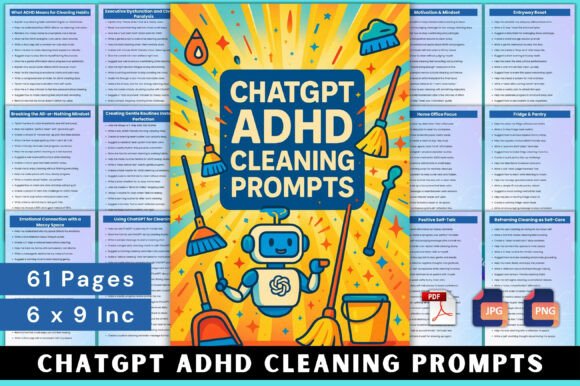
🧠 ChatGPT ADHD Cleaning Prompts is a printable workbook designed to support individuals with ADHD in approaching cleaning tasks with greater clarity, flexibility, and self-compassion. It includes 500 curated prompts—structured around real-world scenarios, energy fluctuations, and common executive function challenges—paired with short timer-based routines (5-, 10-, and 20-minute options), affirmations, and guidance for integrating ChatGPT as a supportive accountability tool. The 61-page PDF, formatted at 6 x 9 inches, emphasizes progress over perfection and frames cleaning as an extension of self-care rather than a test of willpower.
People often seek resources like 🧠 ChatGPT ADHD Cleaning Prompts after experiencing persistent difficulty initiating or sustaining cleaning tasks—not due to lack of effort, but because traditional methods assume consistent attention, working memory capacity, and emotional neutrality toward chores. ADHD-related traits such as task initiation delays, time blindness, emotional dysregulation around “shoulds,” and sensory sensitivities can turn routine tidying into a source of shame or avoidance. This workbook responds directly to those patterns by offering scaffolding that aligns with how many ADHD brains process information and motivation.
The primary benefit lies in its specificity: the prompts are not generic to-do items (“wipe the counter”) but context-aware invitations (“Name one thing on the counter that feels visually calming—and one that doesn’t. Move just the second one”). This subtle shift reduces decision fatigue and builds agency. The inclusion of digital decluttering, emotional connection exercises, and space-specific resets (e.g., “bedroom reset” vs. “kitchen reset”) acknowledges that ADHD challenges manifest differently across environments. Timer routines further support energy-based planning—helpful when motivation isn’t linear and focus windows vary hour to hour.
Another practical strength is its integration framework for ChatGPT. Rather than treating AI as a replacement for human insight, the guide outlines concrete ways to use it—for example, generating personalized reminders, reframing unhelpful self-talk, or adapting a prompt based on current mood or fatigue level. This reflects an understanding that external support tools work best when they’re customizable and low-friction.
However, there are considerations. Because 🧠 ChatGPT ADHD Cleaning Prompts is a static printable resource, it does not adapt in real time to changing needs or provide live feedback. Users who benefit from auditory cues, visual modeling (e.g., video demonstrations), or therapist-led behavioral strategies may find the workbook most effective when used alongside other supports—not as a standalone intervention. It also assumes baseline access to and comfort with printing or digital annotation tools, which may be a barrier for some.
Additionally, while the affirmations and mindset reframes are grounded in ADHD-informed compassion, they are not clinical interventions. Readers managing co-occurring conditions such as depression, anxiety, or OCD should evaluate whether the tone and pacing meet their current emotional capacity—and consider consulting a mental health professional before relying solely on self-guided tools for emotionally charged tasks.
This workbook is likely a strong fit for adults with ADHD who:
- Prefer written, self-paced materials over scheduled programs or apps;
- Respond well to language that names internal experience (“This feels hard because my brain is signaling overwhelm—not because I’m lazy”);
- Already use or are curious about leveraging AI for daily support, and want structured starting points;
- Have tried generic cleaning systems and found them demotivating due to rigid expectations or lack of neurodivergent relevance;
- Value having physical or printable tools they can annotate, highlight, or return to without login requirements or subscription fees.
Conversely, alternatives may be more appropriate in certain situations. For instance, someone who thrives with movement-based or gamified approaches might benefit more from habit-tracking apps with streak features and audio prompts (e.g., Finch or Habitica). Individuals needing immediate, responsive support during moments of high overwhelm may find voice-assisted tools or telehealth coaching more accessible than a static workbook. Those focused specifically on reducing clutter—not just cleaning—might prioritize evidence-based frameworks like the Clutter-Hoarding Scale-informed methods or occupational therapy-led home organization strategies.
It’s also worth noting that effectiveness depends less on the resource itself and more on alignment with personal learning preferences and lifestyle rhythms. A person who rarely prints or prefers digital note-taking may underuse a printable PDF—even if its content is highly relevant. Similarly, someone whose biggest barrier is emotional avoidance around mess (rather than executive function gaps) may need additional support in building distress tolerance before prompts feel usable.
When evaluating whether 🧠 ChatGPT ADHD Cleaning Prompts fits your needs, ask yourself:
- Do I respond better to reflective, language-based tools—or do I need tactile, auditory, or visual input to stay engaged?
- Is my main challenge starting tasks, maintaining momentum, remembering steps, or feeling worthy of a calm environment?
- How comfortable am I adapting written suggestions to my own context—or do I prefer highly prescriptive instructions?
- Do I already use AI tools in daily life, or would learning to integrate ChatGPT add another layer of cognitive load right now?
There’s no universal “best” cleaning system for ADHD. What works depends on individual neurology, environment, support systems, and current life demands. 🧠 ChatGPT ADHD Cleaning Prompts offers one thoughtful, accessible option—one that centers intentionality over intensity and sustainability over speed. Its value emerges not from novelty, but from consistency of design: every prompt, timer suggestion, and affirmation reflects an understanding of how attention, emotion, and action intersect in ADHD daily life.
If you’re looking for a low-pressure, printable companion that meets you where you are—not where productivity culture says you “should” be—this workbook provides a grounded, compassionate entry point. It won’t eliminate all cleaning challenges, but it may change how you relate to them.