1000 Story Seeds Prompts Book
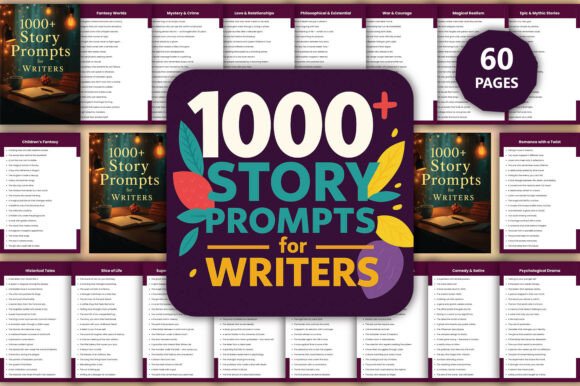
For creators who regularly face the blank page—not as opportunity, but as resistance—the 1000 Story Seeds Prompts Book functions less like a novelty and more like calibrated creative infrastructure. It’s not a writing guide, grammar manual, or publishing roadmap. Instead, it’s a focused, genre-agnostic toolkit designed to interrupt inertia with specificity: one prompt at a time, each engineered to trigger associative thinking, bypass over-editing, and re-engage the instinct to build.
A Resource Built for Real Workflow Integration
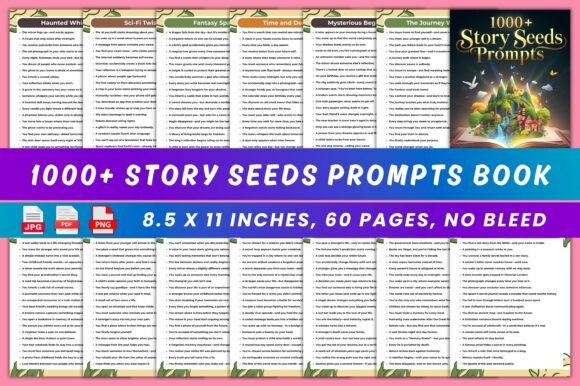
What distinguishes the 1000 Story Seeds Prompts Book from generic prompt lists is its structural intentionality. The 1000 prompts are grouped into 30 genre-themed sections—spanning cosmic horror, cozy mystery, solarpunk romance, bureaucratic fantasy, retro-futurist sci-fi, and more—not as marketing categories, but as functional filters. A screenwriter developing a limited series about intergenerational trauma in a post-climate-collapse setting can turn directly to the “Dystopia & Climate Fiction” section. A poet experimenting with narrative voice might land in “Magical Realism & Folklore.” This organization reduces cognitive load during ideation, especially when time is constrained or focus is fragmented.
The prompts themselves avoid vague directives like “Write about loss” or “Describe a storm.” Instead, they offer grounded, image-rich openings: “A librarian discovers a book that only appears when someone forgets their own name”; “Your character inherits a compass that points not north—but toward the last person who told them the truth”; “A city installs mandatory empathy sensors—and your protagonist’s device registers zero activity, even during grief.” These aren’t just ideas; they’re narrative pressure points, each containing implied stakes, contradictions, and emotional vectors.
Practical Usability Across Roles and Formats
Unlike many creative tools that assume novel-length output, the 1000 Story Seeds Prompts Book accommodates varied output scales and professional contexts:
- Writers drafting short fiction can use prompts as self-contained launchpads—many contain built-in tension, world logic, and character asymmetry.
- Game designers find utility in prompts that suggest mechanics-adjacent concepts (e.g., “A language where verbs change meaning based on who hears them” implies dialogue systems or lore design).
- Educators teaching creative writing report using individual prompts as low-stakes, 10-minute in-class exercises—particularly effective for students resistant to open-ended assignments.
- Content creators and marketers repurpose seeds for blog hooks, social storytelling threads, or brand-aligned micro-narratives—especially those in the “Contemporary Realism” or “Workplace Drama” sections.
The printable digital format (8.5×11 PDF, plus JPG/PNG variants) supports both analog and digital workflows. Writers using bullet journals or Notion templates can embed prompts directly. Educators print single pages for workshops. Freelancers annotate prompts with client-specific constraints—adding “set in Tokyo,” “include three generations,” or “no dialogue”—without altering the core spark.
Quality, Consistency, and Long-Term Utility
Across sampling, the prompts maintain a high baseline of craft-awareness: minimal cliché reliance, consistent grammatical clarity, and deliberate avoidance of culturally reductive tropes (e.g., no “ancient mystical Asian artifact” or “noble savage” framing). While not every prompt will resonate with every user—and no collection of this size could reasonably aim for universal appeal—the distribution feels intentional: roughly 60% lean toward character-driven conceits, 25% emphasize world logic or system-based conflict, and 15% foreground tone, mood, or sensory constraint (e.g., “A story told entirely through grocery receipts”).
This balance supports long-term use. Unlike prompt generators that recycle variations of the same archetype, the 1000 Story Seeds Prompts Book sustains freshness across repeated sessions. One writer noted using it for six months across three distinct projects—novel outlines, podcast episode concepts, and classroom materials—without encountering repetitive scaffolding. That durability stems from editorial curation, not algorithmic volume.
Who Benefits Most—and When
The 1000 Story Seeds Prompts Book delivers strongest value to professionals whose work depends on consistent idea generation under constraint:
- Freelance writers juggling multiple clients benefit from rapid, genre-aligned ideation—especially when pivoting between technical copy, branded storytelling, and speculative fiction commissions.
- Writing instructors appreciate the absence of prescriptive “right answers.” Each prompt invites interpretation, reducing grading subjectivity while encouraging student voice.
- Indie game developers use prompts to stress-test narrative coherence early in design—asking, “Does this seed support meaningful player choice? Does it imply consequence?”
- Small business owners building content libraries (e.g., wellness coaches, financial educators) adapt prompts into relatable client stories—replacing fantasy elements with real-world parallels (“A financial planner discovers a spreadsheet that predicts clients’ money fears before they speak them”).
It’s less suited for users seeking deep instruction on structure, pacing, or revision—or those requiring genre-specific technical guidance (e.g., hard sci-fi physics consistency or romance beat sheets). Its strength lies in initiation, not execution support.
Realistic Considerations and Limitations
No creative tool eliminates the labor of writing—but the 1000 Story Seeds Prompts Book reduces friction at the most common failure point: the first sentence. That said, its effectiveness depends on user engagement style. Readers who expect plug-and-play story blueprints may feel under-served; the prompts require active interpretation, not passive consumption. Similarly, those working in highly specialized niches (e.g., historical naval fiction set exclusively in 18th-century Baltic trade routes) may need to adapt prompts more heavily—though the “Historical Fiction” and “Adventure” sections provide strong foundational entry points.
Also worth noting: the 60-page count reflects density, not brevity. There are no filler pages, explanations, or author commentary—just prompts, cleanly formatted. This makes it efficient but demands that users bring their own contextual knowledge. It assumes familiarity with basic narrative terms (“protagonist,” “stakes,” “setting”) and doesn’t define them.
Final Assessment: A Precision Tool, Not a Magic Wand
The 1000 Story Seeds Prompts Book earns its place not as a replacement for skill or discipline, but as a well-designed lever—one that multiplies existing effort. In practice, it performs reliably across diverse creative roles because it respects process: it doesn’t dictate outcome, impose voice, or assume audience. It offers specificity without prescription, breadth without dilution, and structure without rigidity. For professionals who treat creativity as iterative labor—not sporadic inspiration—it’s less a “spark” and more a dependable striker: always ready, consistently precise, and calibrated to ignite what’s already there.