2026 Anxiety Mega Bundle
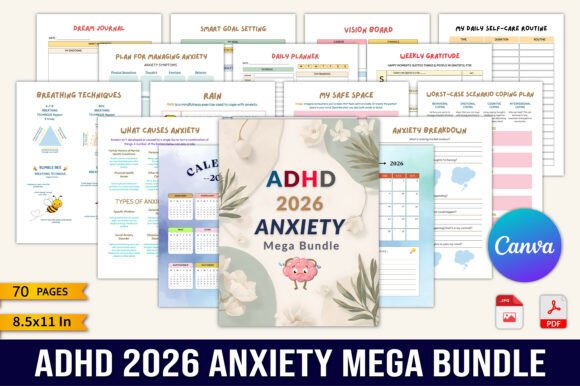
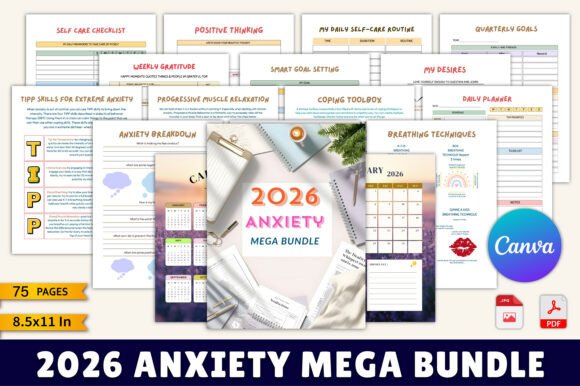
The 2026 Anxiety Mega Bundle is a digital resource collection designed to support individuals managing anxiety through structured self-guided practice. It includes a set of printable and editable tools—worksheets, planners, journals, and mindfulness guides—organized around evidence-informed approaches such as cognitive behavioral therapy (CBT), mindfulness-based stress reduction (MBSR), and behavioral activation.
It is not a clinical treatment or substitute for professional mental health care. Rather, it functions as a supplementary toolkit: a consistent, organized way to engage with daily mental wellness practices. The bundle centers on building awareness, developing coping strategies, and fostering habits that support emotional regulation over time.
Who Might Find This Bundle Helpful?
This resource may appeal to people who:
- Experience mild to moderate anxiety symptoms and are seeking accessible, low-cost ways to build self-management skills;
- Prefer structured, hands-on learning over passive reading or video content;
- Want a single, cohesive system—rather than piecing together separate apps, printables, or journal prompts;
- Value flexibility: the ability to print, write by hand, or edit digitally using Canva;
- Are preparing for or already engaged in therapy and want reinforcement tools between sessions.
It may also suit those who respond well to routine and visual tracking—such as mood logging, habit monitoring, or goal setting—and find consistency helpful in reducing uncertainty, a common anxiety trigger.
What’s Included—and What That Means in Practice
The 2026 Anxiety Mega Bundle organizes its components into functional categories:
- Anxiety Education Worksheets: These explain physiological and psychological aspects of anxiety—including how the fight-or-flight response works, common cognitive distortions, and the feedback loop between thoughts, feelings, and behaviors. They serve best when used alongside reflection or discussion—not as standalone diagnostics.
- Self-Reflection Tools: Trigger logs, thought records, and exposure planning pages invite users to observe patterns without judgment. Their effectiveness depends on regular, honest engagement—not just completion for the sake of checking a box.
- Mindfulness Breathing Guides: Techniques like RAIN (Recognize, Allow, Investigate, Nurture) and box breathing are grounded in research. However, their utility increases with repetition and context—e.g., using grounding prompts during moments of acute stress rather than only during calm periods.
- 2026 Daily Planner: Integrates scheduling with mood tracking and priority setting. Unlike generic planners, it embeds mental wellness prompts directly into daily structure—helping users notice correlations between activities and emotional states over time.
- Gratitude Journaling Pages: Weekly reflections and affirmation prompts align with studies linking gratitude practice to improved emotional resilience. Consistency matters more than volume; even brief, genuine entries can yield benefits.
- Habit and Goal Trackers: Built around SMART criteria (Specific, Measurable, Achievable, Relevant, Time-bound), these encourage incremental progress. They work best when goals are personally meaningful—not externally imposed or overly ambitious.
- Self-Love Motivation Pages: Focus on reframing self-talk and practicing kindness. These address common anxiety-related tendencies like self-criticism or perfectionism—but require willingness to challenge long-standing internal narratives.
Practical Considerations and Tradeoffs
One strength of the 2026 Anxiety Mega Bundle is its modularity: users can adopt only the sections relevant to their current needs—skipping exposure exercises while focusing on breathwork, for example. Its digital format (PDF + Canva link) supports accessibility across devices and preferences for handwriting versus typing.
However, there are limitations to keep in mind:
- No personalization or adaptive feedback: Unlike some apps, it does not adjust based on user input or progress. Users must interpret insights themselves—or bring them to a therapist for deeper analysis.
- Requires self-direction: Success hinges on consistent use and reflective engagement. Without accountability or external guidance, motivation may wane—especially during higher-stress periods when the tools are most needed.
- Not diagnostic or crisis-oriented: It does not include safety planning, suicide prevention resources, or trauma-informed adaptations. Those experiencing severe anxiety, panic disorder, PTSD, or suicidal ideation should prioritize clinical support first.
- Design-focused, not clinically validated: While individual techniques (e.g., box breathing, thought records) have research backing, the bundle itself has not undergone formal evaluation. Its value lies in practical application—not peer-reviewed outcomes.
When This Bundle May Be a Strong Fit
The 2026 Anxiety Mega Bundle tends to be most effective in contexts where:
- A person already understands basic anxiety concepts and seeks consolidation—not introductory education;
- They prefer tangible, analog tools (printed pages, handwritten notes) over screen-based interventions;
- They’re working with a therapist who encourages homework or skill-building outside sessions;
- They’ve tried fragmented resources before and want coherence—a unified system aligned with therapeutic principles;
- They’re entering a new year (e.g., 2026) and want to establish routines rooted in intentionality rather than reaction.
When Alternatives May Be Worth Exploring
This bundle may be less suitable if:
- You need real-time support: mobile apps with guided audio, chat-based coaching, or teletherapy platforms offer immediacy the bundle cannot provide.
- You learn best through auditory or interactive formats: videos, podcasts, or live workshops may resonate more than static worksheets.
- You’re managing complex or co-occurring conditions (e.g., OCD, depression, chronic illness): integrated care from licensed professionals remains essential.
- You prefer minimal structure: some people find detailed tracking overwhelming. Simpler tools—like a blank journal or single-breathing app—may reduce pressure.
- You’re unsure where to begin: free, reputable resources (e.g., NHS Every Mind Matters, CBT-based workbooks from publishers like New Harbinger) offer lower-commitment entry points.
Making an Informed Decision
Before choosing the 2026 Anxiety Mega Bundle, consider asking yourself:
- Do I benefit from writing things down—and am I willing to do so regularly, even when energy is low?
- Am I looking for tools to complement existing care—or hoping this will replace professional support?
- Does the emphasis on self-reflection feel supportive, or might it amplify rumination without guidance?
- How important is customization? If editing templates in Canva feels daunting, printed PDFs alone may limit flexibility.
- What’s my realistic time commitment? Even 5–10 minutes daily adds up—but consistency matters more than duration.
If your answers point toward structure, reflection, and integration of multiple wellness domains (thoughts, behaviors, physiology, environment), the 2026 Anxiety Mega Bundle offers a coherent, reusable framework. If you’re still exploring foundational knowledge or need responsive support, pairing free educational materials with consultation from a mental health professional is often the most grounded next step.