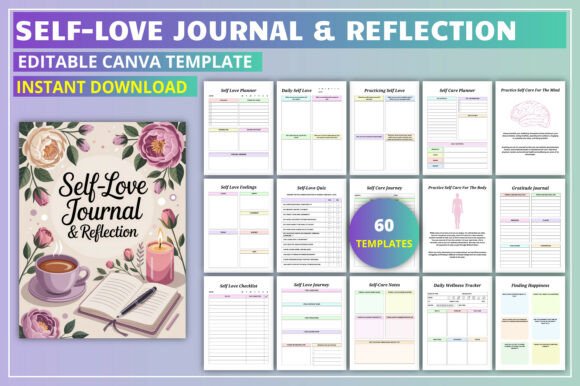
Editable Self-Love Journal Reflection
Building genuine self-love isn’t about perfection—it’s about showing up consistently with kindness, curiosity, and honesty. The Editable Self-Love Journal Reflection supports that practice not as a vague intention, but as a tangible, adaptable tool you shape to fit your life—not the other way around.
A Journal That Grows With You—Not Against You
Most journals ask you to conform: follow rigid prompts, fit into preset layouts, or force your experience into someone else’s structure. This editable version flips that script. Because it’s built for Canva, every page—from the “Belongs To” cover to the “Dear Future Self” letter—is fully customizable. Change fonts to match your calm morning energy or your bold creative phase. Adjust colors to reflect seasonal shifts in mood or intention. Swap out a gratitude tracker for a deeper “Rewrite Your Story” exercise if that’s where your attention lives this week. You’re not filling in blanks—you’re co-creating with yourself.
Practical Clarity for Real-Life Moments
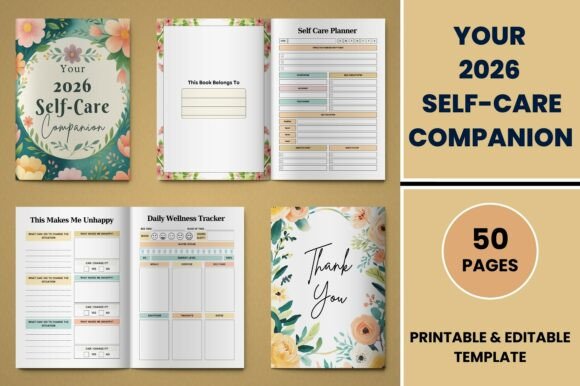
When stress spikes at work or caregiving responsibilities pile up, self-care often shrinks to “I’ll do it later.” The Editable Self-Love Journal Reflection helps reclaim agency in small, grounded ways. Its Daily Weekly Self-Care Planner doesn’t just list “take a walk”—it invites you to name *why* that matters right now (“to reset my nervous system before back-to-back calls”). The Period, Sleep & Mood Tracker reveals patterns invisible in real time—like how low sleep correlates with sharper self-criticism on Tuesdays. That kind of insight doesn’t come from generic advice; it emerges from consistent, personalized reflection.
For Creators Who Value Substance Over Sparkle
If you design digital planners, coach clients, or publish wellness content, this journal serves double duty: as a personal anchor *and* a production-ready asset. Educators can adapt the Challenging Self-Limiting Beliefs worksheet for group workshops. Freelancers building KDP products can rebrand the entire 60-page set—swap logos, adjust spacing for print margins, add custom cover art—and upload directly. No design degree required, but the output feels intentional and cohesive because Canva handles layout logic while you focus on meaning.
Where Structure Meets Sensitivity
The included Self-Love Tree exercise, for example, moves beyond surface-level affirmations. It asks you to root beliefs in lived experience (“What evidence supports ‘I am enough’?”), branch into values-aligned actions (“How does ‘enoughness’ show up in my boundaries?”), and bear fruit through reflection (“When did I choose myself this week?”). That layered approach prevents journaling from becoming ritual without resonance—a common pitfall when tools lack psychological grounding.
Time Saved Is Energy Preserved
Let’s be realistic: most people don’t have hours to build a journal from scratch. Designing even one well-structured gratitude page—complete with visual hierarchy, accessible contrast, and intuitive flow—takes time many simply don’t have. With the Editable Self-Love Journal Reflection, that foundational work is done. You skip the trial-and-error of font pairing or grid alignment and go straight to what matters: your voice, your pace, your priorities. A therapist might add clinical notes to the My Fears page; a writer could expand the Dream Journal section with character prompts; a new parent might simplify the 30-Day Self-Care Challenge into micro-actions like “sip tea while it’s hot.” Customization isn’t a feature—it’s the core function.
Who Benefits Most—and Why
This resource fits especially well for adults navigating transitions: launching a business while managing anxiety, recovering from burnout, healing after loss, or rebuilding identity post-parenthood or career shift. It also resonates with those who’ve tried journaling before but stopped because templates felt alienating—too cheerful, too prescriptive, or too sparse. The inclusion of pages like Brain Dump and Happy Mind – Happy Life acknowledges that self-love includes honoring overwhelm *and* joy—not just one or the other.
That said, it’s not a substitute for clinical support. If persistent hopelessness, dissociation, or emotional numbness are present, working with a licensed professional remains essential. This journal complements care—it doesn’t replace it.
Thoughtful Design Choices, Not Just Pretty Pages
Notice what’s *not* included: forced positivity, shame-based language (“fix your flaws”), or productivity-as-worthiness framing. Instead, prompts invite gentle inquiry: “What would compassion sound like right now?” or “What small act honored my limits today?” Even functional elements—like the To-Do List or Notes pages—are styled to reduce cognitive load, using ample white space and clear typography so mental bandwidth stays focused on reflection, not deciphering layout.
Real Use Cases, Not Hypotheticals
- A marketing consultant uses the Self-Esteem Positive Self-Talk Worksheets to identify automatic thoughts before client pitches—then rewrites them into evidence-based statements (“I prepared thoroughly” vs. “I’ll mess up”).
- An educator adapts the Gratitude Jar Tracker for classroom use, then exports a simplified version for student handouts—keeping their branding intact.
- A small business owner merges the Self-Care Bucket List with their quarterly planning session, turning “book a massage” into “schedule two 45-minute blocks for rest—non-negotiable.”
None of these adaptations require coding, design software, or permission. They happen in minutes, inside a platform most already use.
When Simplicity Serves Depth
Some digital journals overwhelm with animations, auto-saves, or cloud syncs that distract from presence. This editable version embraces simplicity: download once, edit offline or online, print or keep digital. No subscriptions. No logins. No data harvesting. The focus stays on internal dialogue—not interface friction.
And because it’s designed for both screen and paper, you choose your medium based on need—not platform limits. Prefer writing by hand? Print the Daily Journal pages. Need quick access between meetings? Open the Canva link on your phone and jot in the Notes section. Flexibility here isn’t convenience—it’s respect for how humans actually live.
Start Where You Are—Not Where You Think You Should Be
You don’t need to commit to 60 pages at once. Try the Self-Love Feelings Practices for three days. Use the Thank You page to acknowledge one overlooked effort. Let the Dream Journal sit blank for weeks—then return when inspiration strikes. The Editable Self-Love Journal Reflection holds space for inconsistency, curiosity, and quiet growth. It meets you—not the idealized version of you that shows up in Instagram captions.
That’s the quiet power of an editable, thoughtfully structured journal: it doesn’t ask you to become someone new. It helps you recognize, honor, and nurture who you already are.