Chemistry Experiments Workbook
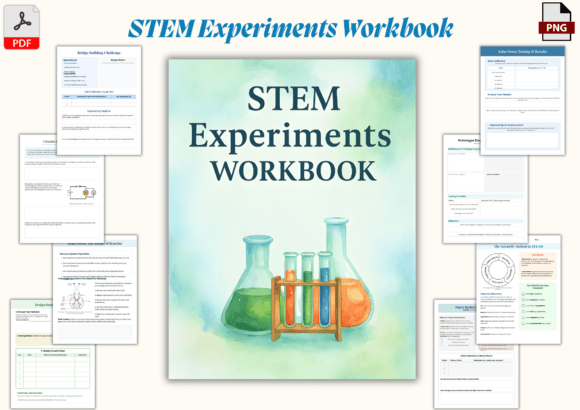
If you're guiding young learners through foundational science—and want to do it without overwhelming prep, costly kits, or disengaged stares—the Chemistry Experiments Workbook offers a refreshingly grounded solution. At just 16 pages and sized to standard US Letter (8.5 x 11 inches), it’s compact enough to slip into a lesson plan or backpack, yet dense with pedagogical intention. It’s not another glossy supplement that gathers dust on a shelf. Instead, it’s built for action: real observation, hands-on testing, and reflective thinking—all using materials already in most kitchens and classrooms.
Why simplicity—done well—matters more than ever
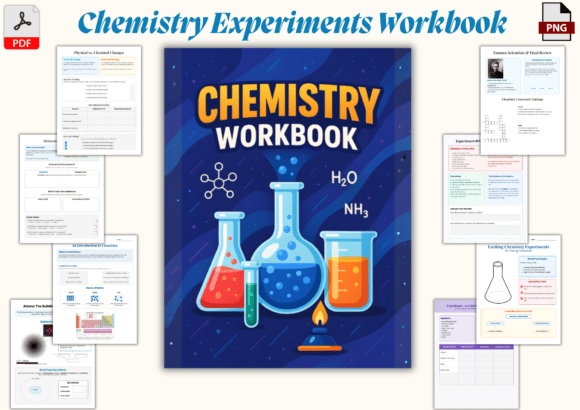
Many educators and homeschooling parents face the same quiet challenge: how to make abstract scientific ideas tangible without sacrificing accuracy or safety. The Chemistry Experiments Workbook meets that need by distilling core chemistry concepts—like acid-base reactions, states of matter, or atomic structure—into scaffolded, illustrated activities. Each worksheet begins with a clear visual: a cartoon-style atom showing electron shells, a pH scale with everyday items (lemon juice, baking soda, soap), or a reaction diagram drawn like a comic strip. These aren’t decorative—they’re cognitive anchors. Research in science education shows that dual-coding (pairing text with meaningful visuals) significantly improves retention, especially for learners aged 8–13. This workbook applies that principle consistently, page after page.
Real experiments, zero lab setup
You don’t need goggles, fume hoods, or a grant to run the vinegar-and-baking-soda volcano—or test household liquids with red cabbage indicator. Every experiment in the Chemistry Experiments Workbook uses safe, accessible materials: salt, food coloring, vinegar, baking soda, zip-top bags, clear cups, and paper towels. That means less time sourcing supplies and more time facilitating inquiry. For a classroom teacher juggling multiple subjects, that’s efficiency with impact. For a homeschool parent managing schedules across ages, it’s flexibility without compromise. One educator we spoke with used the “Reaction Race” activity—comparing how fast effervescent tablets dissolve in warm vs. cold water—as a 20-minute station during a unit on temperature and reaction rates. Students recorded data in the included observation log, then sketched molecular motion in the margins. No printing extra handouts. No last-minute supply runs.
Structure that supports deeper thinking—not just doing
What sets this workbook apart isn’t just the experiments—it’s how they’re framed. Each activity includes space for prediction (“What do you think will happen?”), real-time observation (“Draw what you see at 30 seconds”), and reflection (“Why might temperature change the speed of this reaction?”). These prompts align with evidence-based practices in inquiry-based learning, where metacognition—thinking about one’s own thinking—is as important as the result. In practice, that means students aren’t just watching fizz; they’re practicing scientific language, noticing patterns, and connecting cause to effect. For a science club leader organizing weekly sessions, those reflection sections serve double duty: they generate natural discussion points and provide low-stakes formative assessment. You see how students are reasoning—not just whether they got the “right” answer.
Who benefits most—and when it’s not the right fit
The Chemistry Experiments Workbook is especially valuable for three groups: educators needing adaptable, standards-aligned resources for grades 3–7; homeschool families seeking structured but joyful STEM integration; and informal educators (museums, libraries, after-school programs) who prioritize accessibility and scalability. Its alignment with early science education frameworks—particularly NGSS crosscutting concepts like patterns, cause and effect, and systems—means it complements rather than competes with existing curricula.
That said, it’s intentionally lean. With only 16 pages, it doesn’t replace a full-year curriculum or advanced lab manual. It won’t cover stoichiometry, quantum numbers, or organic nomenclature—and it’s not meant to. If you’re supporting high school AP Chemistry students, look elsewhere. Similarly, if your goal is digital interactivity—drag-and-drop simulations or auto-graded quizzes—this is a print-first resource. Its strength lies in tactile engagement and thoughtful pauses, not flash or automation.
Practical ways to extend its reach
Because it’s offered as both a printable PDF and physical workbook, users can adapt it to their context. A freelance science communicator might embed select pages into a paid mini-course for parents, pairing each experiment with a 90-second explainer video. A small business owner running a children’s STEM camp could print bulk copies, laminate key experiment cards, and rotate them across stations—using the reflection prompts as conversation starters for volunteer facilitators. Even bloggers covering educational tools can use the colorful illustrations and clean layouts as visual references when writing about hands-on science literacy.
A subtle but meaningful design advantage
Notice the size: 8.5 x 11 inches. That’s not arbitrary. It fits standard copy machines, binders, and document cameras—no resizing, cropping, or formatting headaches. For teachers projecting lessons or students scanning work for remote feedback, consistency matters. And because content is intentionally spaced—not crammed—the layout reduces cognitive load. Young readers aren’t scrolling past walls of text or hunting for instructions buried in footnotes. Clarity is baked in.
Final thought: Tools work best when they match your rhythm
The Chemistry Experiments Workbook succeeds because it respects the realities of teaching and learning. It assumes limited prep time. It honors curiosity over perfection. It treats chemistry not as a gatekeeping subject, but as a series of observable, testable, shareable moments. When a student sketches a fizzing reaction and labels the gas bubbles “carbon dioxide,” they’re not just completing a worksheet—they’re building vocabulary, confidence, and scientific identity. That kind of quiet momentum is hard to manufacture, but easy to support—with the right tool in hand.