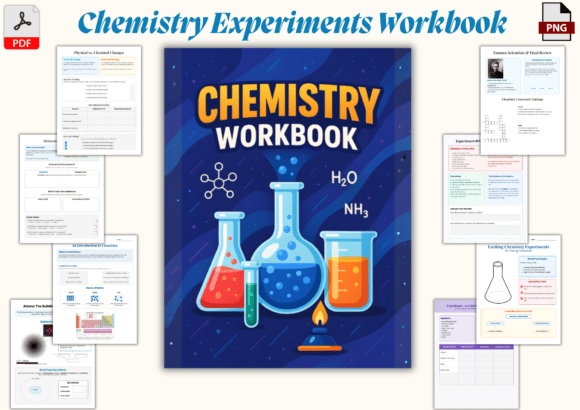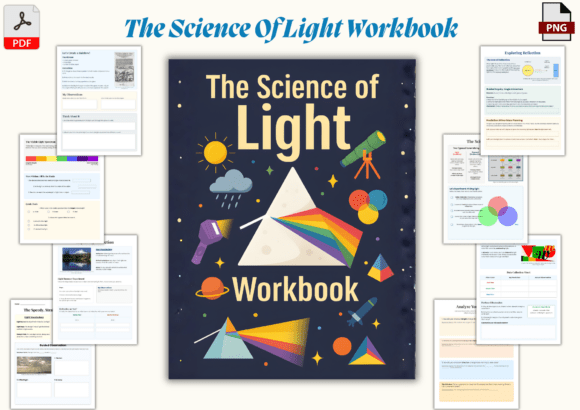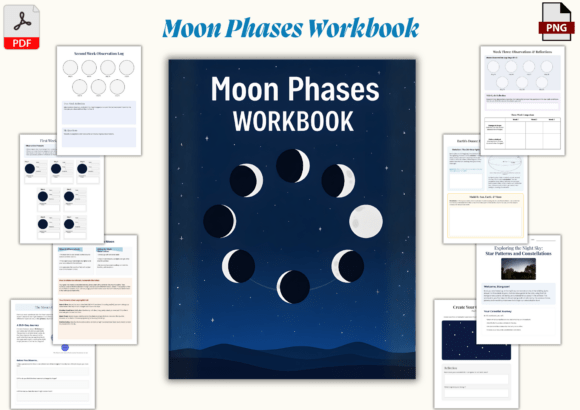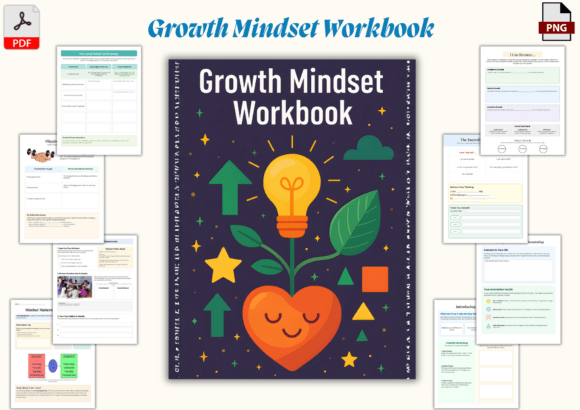
STEM Experiments Workbook
If you’ve ever watched a child light up while building a paper-clip chain reaction, testing how many pennies a foil boat can hold, or sketching predictions before dropping two balls from a balcony—you know real learning doesn’t happen in silence. It happens with scribbled hypotheses, sticky fingers, and that “Wait—why did *that* happen?” pause. That’s exactly where the STEM Experiments Workbook steps in—not as another worksheet stack, but as a ready-to-use catalyst for curiosity across kitchens, classrooms, and after-school nooks.
What It Is (and What It’s Not)
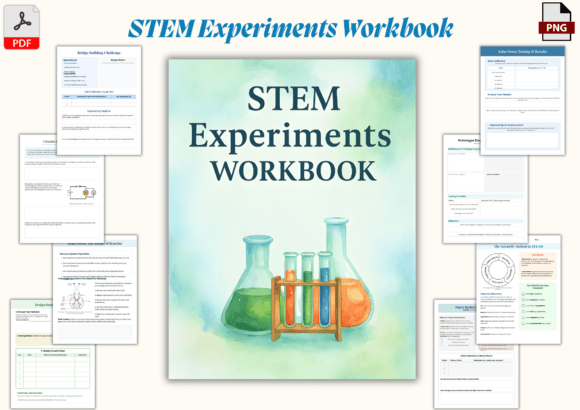
The STEM Experiments Workbook is an 18-page, 8.5 x 11-inch printable resource designed for ages 7–12—but its usefulness stretches far beyond the age range. It’s not a curriculum. It’s not a lesson plan generator. And it’s definitely not a passive coloring book disguised as science. Instead, it’s a tactile, low-prep toolkit: each page scaffolds a hands-on experiment using everyday materials (baking soda, rubber bands, cardboard, water, tape), then invites reflection—not just “what happened,” but “what would change if…?” and “where do we see this in real life?”
Where It Fits—Naturally
Think of the STEM Experiments Workbook like a Swiss Army knife for real-world learning moments—compact, versatile, and quietly powerful. Here’s where it shows up most meaningfully:
- Homeschooling midweek slump? Swap screen time for a 25-minute “Build a Marble Run” challenge. The workbook provides the prompt, space to sketch designs, room to log trial-and-error results, and a gentle nudge toward iteration (“What slowed the marble down? How could you fix it next time?”). No prep, no grading—just momentum.
- Classroom teacher with 45 minutes before lunch? Pull out the “Sink or Swim Density Lab.” Students predict which household items will float in saltwater vs. freshwater, test them, record observations, then discuss why ocean liners float while pebbles sink. The scientific method template on the page keeps inquiry grounded—not abstract, not rushed.
- After-school program leader juggling mixed ages? The engineering challenges—like designing a paper-cup phone that carries sound clearly across 10 feet—scale naturally. Younger kids focus on construction and testing; older ones tweak variables (cord length, cup material, tension) and compare data. Everyone stays engaged, no one waits.
- Grandparent wanting meaningful screen-free time? The watercolor-style visuals and clear step-by-step layout mean you don’t need a science degree to guide it. You ask questions. They try. You both wonder together. That shared “aha” moment? That’s the quiet magic the STEM Experiments Workbook sets up consistently.
Who Benefits—and How Differently
What makes this workbook unusually adaptable is how it serves distinct needs without changing form:
- Teachers appreciate the built-in structure: prediction → procedure → observation → analysis → real-world connection. It saves planning time *and* reinforces NGSS-aligned practices—especially when students revisit their own notes weeks later during a unit on forces or ecosystems.
- Homeschoolers value the portability and reusability. Print once, use across siblings or years. Laminate pages or slip them into dry-erase sleeves for repeated experiments. The PNG files let you project a page onto a whiteboard for group discussion—even remotely.
- Camp coordinators and STEM outreach volunteers rely on its “grab-and-go” reliability. No shipping delays. No inventory tracking. Just open the PDF, print what you need, and start exploring buoyancy, circuits, or plant transpiration—with zero setup anxiety.
- Parents of neurodivergent kids often tell us the visual pacing and dedicated reflection space reduce cognitive load. There’s no wall of text. No ambiguous instructions. Each step breathes. Predictions are drawn or written simply. Results are checked off or sketched—not buried in paragraphs.
Practical Considerations Before You Begin
It’s refreshingly straightforward—but knowing a few nuances helps you get the most from it:
- Materials are intentionally ordinary. You won’t need specialty kits—just things already in your pantry, garage, or craft drawer. That said, having a basic supply kit (measuring spoons, craft sticks, plastic cups, stopwatches or phones for timing) smooths transitions between experiments.
- It assumes adult presence—but not expertise. You’re not expected to explain Archimedes’ principle mid-experiment. You’re invited to explore it *alongside* the learner. The workbook gives you the language (“density,” “force,” “variable”) *in context*, so it sticks.
- It’s designed for doing—not finishing. Don’t feel pressured to complete all 18 pages in order. Pick the one that matches today’s energy level or weather (rainy day? Try the “Rain Gauge Design Challenge.” Sunny? Move outside for the “Shadow Length Tracker.”).
- PDF + PNG means flexibility—not redundancy. Use the PDF for printing or digital annotation (great for tablets with styluses). Use the PNGs for projecting, inserting into slide decks, or adapting for AAC devices or simplified handouts.
Strengths That Stand Out
What separates the STEM Experiments Workbook from similar resources isn’t novelty—it’s intentionality:
- Reflection is baked in—not tacked on. Every experiment includes dedicated space for predictions *before* trying, sketches *during*, and analysis *after*. That habit—pausing to notice, question, and connect—is where deep learning takes root.
- Real-world links feel authentic, not forced. After building a simple lever, the workbook asks: “Where do you see levers at the playground? In your kitchen? At a construction site?” It grounds abstract ideas in lived experience.
- Watercolor-style art supports focus, not distraction. Soft edges and gentle color palettes keep attention on the activity—not flashy graphics competing for mental bandwidth.
A Note on Limits—So You Can Plan Realistically
It’s not meant to replace lab equipment, certified curricula, or long-term project mentorship. If you’re preparing students for advanced science fairs or coding competitions, this is a strong starting point—not the finish line. It also doesn’t include answer keys (by design—science isn’t about right answers, but evidence-based reasoning). And while it’s highly accessible, very young readers (under age 7) may need verbal support reading instructions—though many thrive with audio-assisted use or co-creation with an adult.
Ultimately, the STEM Experiments Workbook works because it meets learners—and the adults who guide them—where they are: curious, capable, and ready to make sense of the world through doing. Not watching. Not memorizing. But building, testing, revising, and wondering—again and again.