How the Christmas Wish Journal Activity Book Cultivates Meaningful Holiday Engagement for Children and Educators
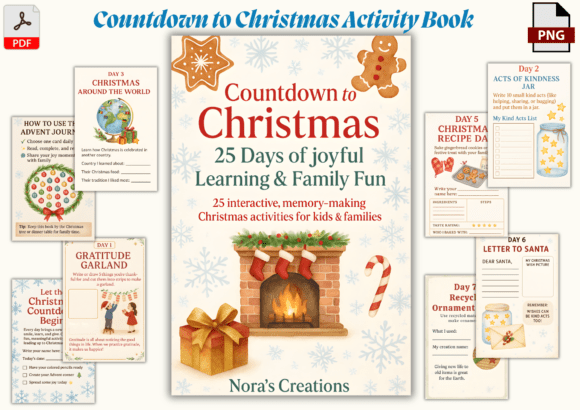
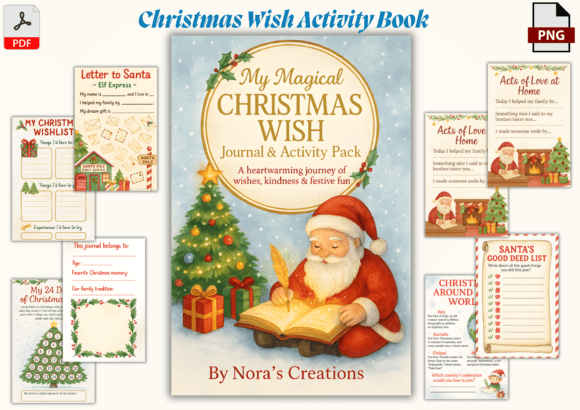
The Christmas Wish Journal Activity Book—officially titled 🎄 My Magical Christmas Wish Journal Activity Pack ✨ By Nora’s Creations—is more than a seasonal printable; it’s a thoughtfully scaffolded tool for emotional development, cultural literacy, and joyful reflection during one of the most sensorially rich and emotionally charged times of the year. Unlike generic holiday worksheets or passive coloring sheets, this 20-page activity pack integrates evidence-informed practices from child development, social-emotional learning (SEL), and experiential education into a cohesive, aesthetically grounded experience. Its design reflects an understanding that meaningful engagement with tradition isn’t about rote repetition—it’s about invitation, agency, and personal resonance.
Structure as Pedagogy: Why Page Order Matters
Each page in the Christmas Wish Journal Activity Book functions as both an independent prompt and a node in a larger developmental arc. The sequence begins not with Santa—but with self. Early pages invite children to reflect on gratitude using open-ended prompts like “Three things that made me smile this week” paired with space for drawing. This grounding in internal awareness precedes external expressions—like writing letters to Santa—so wishes emerge from a place of presence rather than consumer-driven impulse. Similarly, the Acts of Kindness Tracker appears before the Wish List, subtly reinforcing that contribution often precedes receipt—a principle aligned with research on prosocial behavior and long-term life satisfaction.
This intentional sequencing mirrors best practices in classroom SEL curricula, where skill-building follows a progression: self-awareness → self-management → social awareness → relationship skills → responsible decision-making. Educators report that when students complete the Christmas Around the World page—featuring simplified icons and age-appropriate facts about celebrations in Mexico, Ethiopia, Japan, and Finland—they approach their own traditions with greater curiosity and less assumption. One third-grade teacher in Portland noted how her students used the page to compare Las Posadas processions with local neighborhood light parades, sparking a cross-curricular unit on community ritual.
Practical Flexibility Across Contexts
The Christmas Wish Journal Activity Book was built for adaptability—not just in format (PDF and PNG), but in function. Its 6x9-inch dimensions make it ideal for individual use at home, yet its clean layout and scalable illustrations allow seamless projection for group facilitation. In therapeutic settings, clinicians use the Thank You Note Template to support children navigating grief or family transition—shifting focus from absence to connection through language that affirms agency (“I am thankful for…” rather than “I miss…”). Homeschooling families integrate the Baking Family Reflection Page into real-world math and science lessons: measuring conversions, observing chemical reactions in dough, or documenting sensory changes before and after baking.
For gift bundling, the journal’s watercolor aesthetic provides cohesion alongside tactile items—think cinnamon-scented playdough, handmade ornaments, or locally sourced hot chocolate mix. Retailers who include the Christmas Wish Journal Activity Book in curated holiday boxes report higher repeat purchase rates, citing customer comments like “It gave our kids something to *do* together—not just unwrap.” That distinction—between consumption and co-creation—is central to its utility.
Design Choices with Developmental Intent
Every visual and textual element serves a functional purpose:
- Watercolor illustrations avoid overstimulation while offering gentle visual anchors—critical for neurodiverse learners who benefit from low-contrast, non-distracting backgrounds.
- Dual-format delivery (PDF + PNG) supports accessibility: PDF preserves layered text for screen readers and editable fields; PNG enables cutting, laminating, or digital annotation in tools like Seesaw or Google Slides.
- Open-ended prompts (“Draw what kindness looks like to you”) honor varied expression styles—some children write paragraphs; others fill pages with symbols, patterns, or collaged scraps. There is no “right answer,” reducing performance anxiety.
- Repetition with variation appears across trackers: the Christmas Countdown uses stars, the Kindness Chart uses snowflakes, and the Gratitude Log uses ornaments. This consistency builds routine without monotony—a key factor in sustaining engagement across December’s busy weeks.
Educational Integration Beyond the Holidays
While rooted in Christmas, the Christmas Wish Journal Activity Book cultivates transferable competencies. The Design Your Own Reindeer Game page, for example, requires rule-setting, spatial reasoning, and iterative testing—practicing computational thinking without screens. Students prototype games using household items, then refine based on peer feedback, mirroring design-thinking frameworks used in STEM education.
Similarly, the Certificate of Kindness isn’t merely celebratory—it introduces foundational concepts of recognition systems and intrinsic motivation. When teachers pair it with class meetings where students nominate peers using specific, observable behaviors (“I saw Maya share her markers without being asked”), they reinforce descriptive praise over vague labels—a technique shown to increase resilience in early childhood studies.
Even the Letters to Santa template avoids prescriptive phrasing. Instead of “I want…”, it offers sentence stems like “This year I learned how to…” or “Something I helped with was…”—inviting narrative identity formation. Researchers at the University of Wisconsin found that children who regularly articulate growth-oriented reflections demonstrate stronger metacognitive awareness by mid-elementary school.
Considerations for Thoughtful Implementation
As with any resource, effectiveness depends on context and intention. Educators should consider:
- Timing: Introduce the journal early in December—not during final-week chaos—to allow space for reflection and revision. One Montessori school spaces activities across three weeks, dedicating each Friday to a themed “journal circle.”
- Modeling: Adults who write alongside children (e.g., completing their own gratitude log or kindness tracker) significantly increase participation and depth of response.
- Inclusion: While centered on Christmas, the journal’s emphasis on universal values—gratitude, generosity, belonging—makes it adaptable. Families observing other winter holidays often substitute “Santa” with “a special person who brings joy” or repurpose the Christmas Around the World page to explore their own heritage traditions.
- Archiving: Because it’s printable, families can bind completed journals into keepsakes. Some scan pages annually to create digital timelines showing evolving handwriting, vocabulary, and emotional articulation—a tangible record of growth.
Why This Resonates in Today’s Landscape
In an era marked by shortened attention spans and rising childhood anxiety, the Christmas Wish Journal Activity Book offers something increasingly rare: sustained, low-pressure engagement with meaning-making. It doesn’t compete with screens—it creates a parallel rhythm: quiet time for writing, shared time for baking reflections, collaborative time for designing sleighs. Its popularity among occupational therapists, faith-based educators, and Waldorf-inspired programs signals broader recognition that ritual, when personalized and participatory, builds regulatory capacity.
What distinguishes it from comparable resources is its refusal to flatten complexity. It acknowledges that Christmas can hold joy and sadness, anticipation and fatigue, abundance and scarcity—all within the same child’s experience. The Family Baking Reflection asks, “What did we laugh about?” and “What felt hard today?” side by side. That balance—honoring nuance without burdening young writers—is where its quiet expertise lies.
Ultimately, the Christmas Wish Journal Activity Book succeeds not because it checks seasonal boxes, but because it treats childhood as a site of ongoing inquiry—not preparation for adulthood, but full participation in human experience. Whether used nightly at the kitchen table, during morning meeting in a public school, or as part of a therapist’s toolkit, it meets children where they are: curious, capable, and deeply attuned to the magic embedded in ordinary moments—especially when those moments are named, drawn, written, and kept.