🌿 2026 Mental Health Journal
A Thoughtful Companion for Intentional Living in the New Year
As we approach 2026, many of us are rethinking how we show up for ourselves—not just in moments of crisis, but in the quiet, everyday choices that shape emotional resilience. The 🌿 2026 Mental Health Journal meets this need with grounded intention: it’s not a productivity hack or a rigid schedule, but a compassionate, flexible tool designed to deepen self-awareness, reduce overwhelm, and nurture consistent self-care—without demanding perfection.
What Makes This Journal Different?
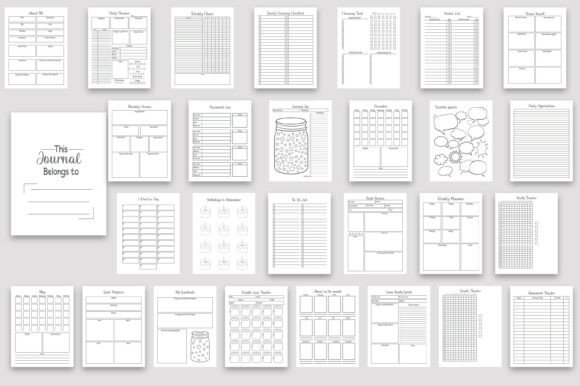
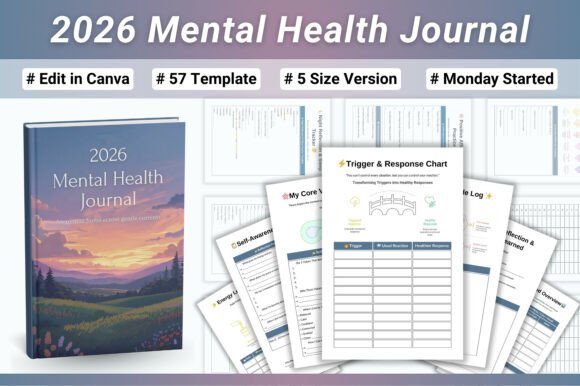
Unlike generic planners or bullet journals that prioritize output over inner experience, the 🌿 2026 Mental Health Journal centers mental wellness as an active, evolving practice. Its 57-page structure is intentionally curated—not bloated with filler, but layered with purpose. Every section invites reflection before action, awareness before adjustment.
It’s built around three core principles:
- Accessibility: Available in five print sizes—US Letter, A4, A5, 6x9, and Half US Letter—so it fits your preferred format, whether you’re journaling at a desk, tucking pages into a notebook, or traveling light.
- Flexibility: All reflection templates are undated, meaning you can start anytime—even mid-year—and adapt pacing to your rhythm, not a calendar’s demand.
- Integration: Blends practical tracking (mood, stress triggers, sleep, energy) with embodied practices (mindfulness prompts, gratitude logs, affirmation creation) so insight leads naturally to gentle shifts.
Inside the Pages: Tools That Work With Your Life
The 🌿 2026 Mental Health Journal avoids one-size-fits-all rigidity. Instead, it offers modular, interwoven tools—each serving a distinct yet connected role in sustaining emotional balance:
🧠 Mindfulness & Mental Clarity Sections
The monthly calendar notes aren’t just for appointments—they include space for “mental weather checks”: brief reflections on focus, mental fatigue, or cognitive load. Paired with Stress Trigger Logs, these help identify subtle patterns—like how back-to-back Zoom calls drain attention more than meetings themselves. Real users report spotting early warning signs of burnout weeks before symptoms escalate.
💖 Self-Care & Emotional Wellness Planning
Daily Gratitude Positivity Logs encourage micro-moments of noticing—not forced positivity, but grounded appreciation (“the warmth of my coffee,” “a text from my sister”). Morning and Evening Reflection Sheets gently anchor transitions: “What do I need to release today?” or “What small act felt nourishing?” These aren’t chores; they’re invitations to return home to yourself.
✏️ Practical Design for Real-World Use
Print-ready PDF format means no subscription, no app dependency, no login friction. It works offline, on recycled paper, in a café, or beside your bed. Many therapists recommend it to clients who prefer tangible, screen-free processing. Educators use it in wellness workshops. Small business owners integrate its Self-Care Routine Tracker into team check-ins—not as surveillance, but as shared language for sustainable pace.
Who Benefits Most From the 🌿 2026 Mental Health Journal?
This isn’t just for people in active therapy or those managing clinical diagnoses. Its strength lies in universality—meeting people where they are:
- Creatives & freelancers navigating irregular schedules find stability in the Undated Reflection Templates—tracking creative energy alongside mood, not just deadlines.
- Parents and caregivers use the Stress Trigger Log to map emotional spikes tied to specific routines (e.g., school drop-offs), then adjust boundaries with clarity—not guilt.
- Remote workers rely on the Morning Reflection Sheet to separate “work mode” from “human mode,” reducing digital fatigue and decision fatigue.
- Students and recent graduates lean into the Affirmation Creator during transition periods—crafting statements rooted in growth (“I am learning to trust my pace”) rather than performance.
- Healthcare professionals and educators often reprint select pages (like the Emotion Tracker or Mindfulness Practice Prompts) for personal use or low-barrier client handouts.
Real-Life Applications: Beyond the Page
One occupational therapist shared how she uses the 🌿 2026 Mental Health Journal with teens: printing only the Mood Emotion Tracker and Gratitude Log on colorful paper, pairing them with art supplies. The visual, tactile process lowers resistance to emotional naming—turning abstract feelings into something concrete and safe to explore.
A small design studio adopted the Self-Care Routine Tracker across their team. Each Friday, members share *one* self-care action they completed—not to compare, but to normalize rest as infrastructure. Over months, meeting fatigue dropped 30%, and unplanned PTO requests decreased significantly.
For someone recovering from anxiety, the “Mental Clarity Reflection Pages” became a lifeline—not by eliminating worry, but by creating distance: “Is this thought mine—or something I absorbed?” That simple distinction, practiced weekly, rewired habitual responses.
What to Keep in Mind: Strengths & Considerations
The 🌿 2026 Mental Health Journal excels when used with curiosity, not compliance. Its biggest strength—flexibility—is also its only limitation: it won’t force discipline. You won’t be nudged with notifications or locked into streaks. That’s intentional. It assumes you already hold wisdom about your needs—you just need a clear container to listen.
It’s not a replacement for clinical support. If you’re experiencing persistent hopelessness, panic, or dissociation, pairing journaling with professional care strengthens both. Think of it as a companion to therapy—not a substitute.
Also, while the PDF is optimized for crisp black-and-white printing, some users enhance pages with colored pens, washi tape, or watercolor washes. Its clean, uncluttered layout leaves room for personalization without visual noise.
Evaluating Fit: Is This Right for You?
Ask yourself:
- Do you want a tool that supports awareness first, not just action or output?
- Do you prefer analog, tactile engagement over apps—or value having both options?
- Are you seeking structure that adapts to your energy, not the other way around?
- Do you value simplicity with depth—pages that feel spacious, not sparse?
If most answers are “yes,” the 🌿 2026 Mental Health Journal aligns. It’s especially powerful if you’ve tried journaling before but stopped—often because formats felt too prescriptive, too vague, or too disconnected from daily emotional reality.
Starting Simple: Your First Week With the Journal
You don’t need to begin on January 1st—or fill every page. Try this:
- Day 1: Print just the Daily Gratitude Positivity Log. Write three small, sensory-based things—no grand declarations needed.
- Day 3: Flip to the Stress Trigger Log. Note one moment that left you tense. What happened right before? What did your body feel?
- Day 6: Use the Morning Reflection Sheet for 90 seconds. Ask: “What do I truly need to honor today?”
No analysis. No editing. Just showing up—with kindness, not judgment.
Final Thought: Wellness as a Practice, Not a Destination
The 🌿 2026 Mental Health Journal doesn’t promise transformation overnight. It offers something quieter, and more lasting: the chance to meet yourself again and again—with patience, precision, and grace. In a world pulling us toward speed and scale, it holds space for slowness, subtlety, and self-trust. Whether you’re stepping into a new year, a new role, or simply a new relationship with your own mind—it meets you there, page after thoughtful page.