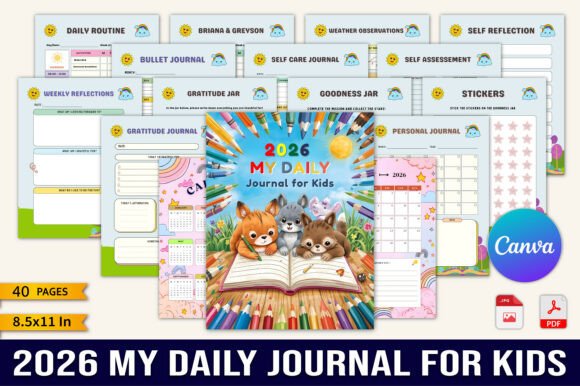
2026 My Daily Journal for Kids
If you’re a parent, teacher, counselor, or caregiver looking for a gentle, joyful way to support a child’s emotional development in the new year — not with worksheets or rigid rules, but with color, choice, and quiet moments of connection — the 2026 My Daily Journal for Kids is more than a planner. It’s a soft landing place for big feelings, a launchpad for small wins, and a low-pressure invitation to notice what matters.
Think about the child in your life who rushes through mornings without pausing, who struggles to name emotions beyond “fine” or “mad,” or who lights up when handed colored pencils but shuts down during “reflection time.” This journal meets them where they are — not as a tool to fix, but to accompany.
Real-Life Moments Where This Journal Makes a Difference
At home before school: A 7-year-old flips open the Morning Routine Checklist — not as a chore list, but as a playful “Yes I Did!” tracker with smiley-face stickers she adds herself. She checks off “I drank water,” “I hugged someone,” and “I took three slow breaths.” That five-minute ritual doesn’t just build consistency — it shifts her nervous system before the school bell rings.
In a busy classroom: A third-grade teacher uses the Mood Weather Tracker during morning meeting. Instead of asking “How are you?”, she invites kids to draw today’s weather: “Is it sunny with one cloud? Stormy with rainbows inside?” One shy student draws a thundercloud with a tiny sun peeking out — and later shares, “My dog got sick, but I got to hold him all night.” The journal becomes a bridge between inner experience and outward expression — no pressure, no performance.
During after-school transitions: A preteen who feels overwhelmed by homework, soccer practice, and sibling squabbles uses the Gratitude Goodness Jar page to jot down one thing she did that made someone else smile — even if it was just passing the snack bowl. Over time, she starts noticing patterns: “When I help my brother tie his shoes, I feel calm.” That awareness builds emotional literacy faster than any lecture ever could.
Who Benefits — And How
- Parents of neurodivergent kids: The visual structure (color-coded sections, icons instead of dense text) reduces cognitive load. The Habit Self-Care Tracker isn’t about perfection — it’s about noticing: “Did I wiggle my fingers? Did I step outside? Did I say ‘no’ to something that felt too much?” These micro-choices reinforce agency, especially for kids who often feel directed rather than consulted.
- Elementary school counselors: Use the Vision Board Reflection Pages in small groups to explore identity and possibility without labels. “What does ‘brave’ look like in your hands? In your voice? In your feet?” Doodling answers opens doors that direct questions sometimes close.
- Grandparents and caregivers: The editable Canva link means you can personalize pages — add photos, swap affirmations (“I am learning” instead of “I am perfect”), or translate gratitude prompts into another language. It becomes a living document shaped by love, not a static product shipped from afar.
- Homeschooling families: The Savings Tracker with its heart-filled chart turns abstract money concepts into tangible growth — “Every time I save $1, I fill part of this heart. When it’s full, we’ll bake cookies together.” It links delayed gratification to shared joy, not just future reward.
Practical Considerations Before You Begin
This isn’t a “set it and forget it” resource — and that’s intentional. Its strength lies in flexibility, not uniformity. Here’s what helps it land well:
- Start small, not daily: Even two minutes with the Doodle Creativity Section — no theme, no prompt, just crayons and blank space — builds safety with self-expression. Consistency grows from enjoyment, not obligation.
- Model, don’t mandate: Try filling out your own version alongside your child — not to “teach,” but to show that noticing feelings, setting tiny goals, and celebrating small joys is lifelong work, not just kid stuff.
- It’s not therapy — but it can support it: For children working with therapists or coaches, many pages align beautifully with evidence-based practices (like CBT grounding techniques in the Mood Weather Tracker or narrative therapy principles in the Daily Journal Pages). Share it with their care team — they may suggest gentle adaptations.
- Watch for resistance — and honor it: If a child closes the journal or says “I don’t know what to write,” that’s data — not failure. Try swapping pen for voice note, drawing for writing, or using the Gratitude Goodness Jar as a family game at dinner (“One thing I saw today that made me pause…”).
What Sets the 2026 My Daily Journal for Kids Apart
Unlike generic journals with vague prompts or overly academic layouts, this one speaks kid-language fluently — while quietly building adult-capable skills. The Full 2026 Calendar includes space for birthdays, holidays, and “my favorite day so far” — making time feel meaningful, not just measured. The Goal Setting Pages separate “personal,” “health,” “creative,” and even “financial” goals — not to pressure kids into adulthood, but to normalize that growth happens across many kinds of spaces.
And because it’s designed for real life — not ideal life — it includes blank “Oops!” pages for days missed, doodle margins for wandering thoughts, and heart-shaped checkmarks instead of stern checkboxes. It assumes kids will forget, change their minds, draw outside the lines, and still be worthy of celebration.
A Note on Limits — and Liberation
This journal won’t replace conversations, professional support, or the messy, beautiful work of parenting. It won’t magically resolve anxiety, ADHD-related overwhelm, or grief — but it can offer steady ground to stand on while those things are being navigated. It’s also not meant for every child at every age: some may find the structure soothing; others may need even more open-ended tools first. That’s okay. Its value isn’t in universal fit — it’s in offering one more thoughtful, colorful option in a world full of rushed, screen-heavy alternatives.
Ultimately, the 2026 My Daily Journal for Kids is an act of quiet belief: belief that children already hold wisdom, creativity, and resilience — and that sometimes, all they need is the right kind of paper, a few gentle prompts, and the permission to begin exactly where they are.