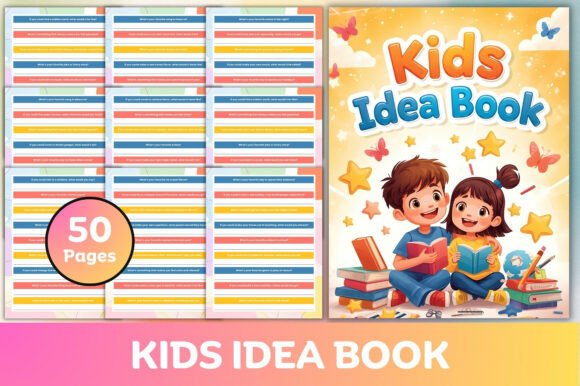
Kids’ Idea Book
If you’re a parent, teacher, homeschooler, or creative professional supporting young minds, the Kids’ Idea Book isn’t just another printable—it’s a thoughtfully designed catalyst for imagination. With 400 open-ended prompts, questions, and activity starters, it invites children aged preschool through elementary to draw, write, wonder, and express themselves without rigid rules or right answers. Its strength lies in flexibility: one child might sketch a robot that sings lullabies; another may write a letter from a cloud to a caterpillar. That range is intentional—and powerful.
What People Often Misunderstand About the Kids’ Idea Book
Many assume this is a workbook with step-by-step instructions or coloring pages. It’s not. The Kids’ Idea Book intentionally avoids prescriptive tasks—no “draw a house here” or “fill in the blank.” Instead, prompts like “What would your shadow do if it could talk?” or “Design a snack that makes you brave” leave space for original thinking. Confusing it with structured curriculum materials leads to underuse—or worse, disappointment when kids don’t “complete” it like a worksheet.
Another common oversight? Assuming age ranges are rigid. While labeled “preschool to elementary,” the real value emerges when adults adapt prompts—not skip them. A 4-year-old might dictate a story about talking rainbows while a 9-year-old expands it into a comic strip. The book works best when treated as a shared tool, not a solo assignment.
Printing & File Format Pitfalls (and How to Avoid Them)
The Kids’ Idea Book comes in PDF, PNG, and JPG formats—all at 300 dpi and sized to standard 8.5 × 11 paper. That sounds straightforward—until someone opens the PNG file in a basic photo app, resizes it without preserving resolution, and prints a blurry page. Or downloads the PDF but opens it in a browser instead of Adobe Acrobat, causing misaligned margins or missing fonts.
Here’s what to check before printing:
- Use the PDF version for best results—it’s print-optimized with embedded fonts and consistent spacing.
- Print at “Actual Size” or “100% scale”—not “Fit to Page,” which distorts layout and shrinks prompts.
- Verify your printer settings: Choose “High Quality” or “Best” mode, especially for drawing pages where line clarity matters.
One educator printed the first 10 pages using “Fast Draft” mode—her students struggled to see faint prompt text. Switching to “Best” quality took 30 extra seconds per page but transformed usability. Small setting choices have outsized impact on engagement.
Why “Ready-to-Use” Doesn’t Mean “No Prep Needed”
The listing says “50 Pages ready for KDP upload” and “ready to use”—and it is. But “ready” refers to technical readiness, not pedagogical plug-and-play. Teachers sometimes assign pages cold, expecting immediate deep engagement. Yet kids respond more fully when prompts are introduced with context: a quick read-aloud of a sample response, a shared sketch on the board, or connecting a prompt to something they’ve recently read or experienced.
For example, the prompt “Invent a holiday no one celebrates yet—but everyone should” lands differently after reading a book about cultural traditions versus as a standalone worksheet. The Kids’ Idea Book thrives on scaffolding—not isolation.
Gift-Giving Assumptions That Backfire
It’s marketed as a “perfect gift for creative kids”—and it is—but gifting it without framing can dilute its impact. Handing a 7-year-old the full 50-page PDF with no guidance often leads to flipping through once and setting it aside. Better: print 3–5 favorite prompts, staple them into a mini booklet, and include a note like, “Let’s try one together this weekend.” Or pair it with a set of colored pencils and say, “These are for your idea adventures.”
One parent bought the Kids’ Idea Book for her daughter’s birthday, printed everything, and left it on the desk. Two weeks passed with zero use. Then she selected just *one* prompt—“Draw your dream treehouse and name every room”—and sat beside her daughter for 12 minutes while she sketched. That single session sparked three more that week. Intentional entry points matter more than volume.
What to Verify Before Downloading or Purchasing
Before finalizing a purchase or download, ask yourself:
- Do I understand how I’ll introduce it? If your plan is “I’ll give it to them and see what happens,” consider reviewing 5 prompts first and jotting down how you’d model one.
- Do I have reliable access to a quality printer—or am I planning digital use? The PDF works well on tablets with annotation apps (like GoodNotes or Notability), but handwriting on screen requires a stylus and some practice. Don’t assume digital = easier.
- Is my goal skill-building, emotional expression, or joyful play? The Kids’ Idea Book supports all three—but leans strongest toward open-ended exploration. If you need aligned Common Core writing standards or rubrics, this isn’t a replacement for curriculum—it’s a complement.
Realistic Expectations for Long-Term Use
This isn’t a “finish-in-a-week” resource. Its value compounds over time: a child revisiting the same prompt months later may answer it in a completely new way—revealing growth in empathy, logic, or vocabulary. One third-grade teacher uses one prompt weekly as a “thinking warm-up,” rotating through drawing, writing, and discussion versions. She keeps a class journal where responses accumulate—not for grading, but for reflection. By May, students notice their own shifts: “I used to draw only dragons. Now I draw dragons who help lost stars.”
That kind of metacognitive awareness doesn’t happen from speed or quantity. It grows from consistency, low pressure, and adult presence—even quiet presence. The Kids’ Idea Book gives structure to spontaneity. But structure alone won’t spark imagination. You do.
A Final Note on Quality and Presentation
Because the interior files are print-ready at 300 dpi and follow standard dimensions, they hold up professionally—whether you’re binding copies for a classroom, uploading to KDP for resale, or printing at home. But presentation extends beyond pixels. Consider how you store or share it: laminated prompt cards on a ring, a dedicated “idea jar” with printed slips, or a bulletin board section titled “This Week’s Wonder Prompt.” How it’s framed shapes how seriously kids take it.
Ultimately, the Kids’ Idea Book works best when treated not as a product to consume, but as a practice to return to—with curiosity, patience, and the willingness to wonder alongside the child.