Kind Kids Stories
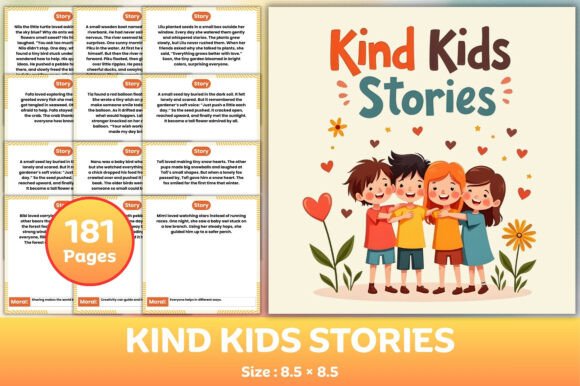
For creators, educators, and small publishers building meaningful children’s content—Kind Kids Stories isn’t just another story collection. It’s a strategically designed asset: 180 short, morally grounded tales that operate at the intersection of developmental psychology, classroom utility, and scalable publishing. Each story is intentionally concise—designed for attention spans under six minutes—and built around observable behaviors: sharing without prompting, listening before speaking, helping without being asked. That specificity matters—not because it sounds nice, but because it creates measurable alignment between intent and outcome.
Why Structure Matters More Than Volume
Many well-intentioned creators assume “more stories = more value.” But in early childhood literacy and character education, density without design dilutes impact. Kind Kids Stories avoids this by anchoring every narrative to one core behavior—patience in “The Turtle Who Waited,” empathy in “Firefly Finds a Friend,” courage in “Lily and the Storm Door.” This singular focus makes each story functionally reusable: a teacher can select “The Turtle Who Waited” not just for reading time, but as a touchpoint during transitions, a reference during conflict resolution, or a prompt for drawing-and-tell activities. The structure enables intentionality—not just consumption.
Strategic Use Across Roles
How you apply Kind Kids Stories depends on your role—and your goals.
- Educators: Use individual stories as low-prep social-emotional learning (SEL) anchors. Print one per week as a laminated “Kindness Card” for morning meetings. Pair with a two-sentence reflection prompt (“When did you wait like the turtle?”) instead of abstract questions. This builds consistency without adding planning time.
- Publishers & KDP Creators: The included 300 dpi PNG and JPG files aren’t just production-ready—they’re platform-optimized. You can extract single-story visuals for Pinterest pins, Instagram carousels, or Amazon A+ Content without redesigning. That turns one asset into multiple touchpoints—reducing creative overhead while increasing discoverability.
- Curriculum Designers: The 8.5 × 8.5 inch layout matches standard printing specs used by school districts and homeschool co-ops. That means no reformatting before bulk printing—cutting lead time from weeks to hours when fulfilling orders or preparing workshop kits.
- Gift Product Developers: Because the interior is print-ready and thematically unified, bundling Kind Kids Stories with a kindness journal or a set of emotion cards creates a cohesive, values-aligned product line—not a random assortment. That coherence increases perceived value and repeat purchase likelihood.
When Context Overrides Convenience
Having Kind Kids Stories doesn’t guarantee impact—it guarantees opportunity. The risk isn’t in the content itself, but in how it’s deployed without alignment to real-world constraints. For example:
- A preschool using all 180 stories over a semester—without mapping them to observed behavioral goals—creates noise, not growth. Children don’t absorb “kindness” as a concept; they internalize it through repetition of specific, modeled actions. Selecting 12 stories aligned to your program’s SEL benchmarks yields deeper integration than rotating through 60.
- A blogger embedding full stories in posts risks duplicate content penalties and weakens their own voice. Instead, use one story as an illustrative anchor—then pivot to analysis: “Why does this firefly story work where others fail? Notice how the problem isn’t solved by adult intervention—but by peer observation and gentle mimicry.” That adds original insight while leveraging the story ethically.
- A freelance illustrator treating the PNG files as final assets misses a strategic opening. Those images are starting points—not endpoints. Reskinning characters to reflect local diversity, regional animals, or inclusive family structures transforms a ready-made resource into a differentiated offering—without rebuilding from scratch.
Planning for Long-Term Utility, Not Short-Term Output
Think beyond “What do I publish next?” toward “What do I want this to enable three years from now?” Kind Kids Stories supports long-term positioning when treated as infrastructure—not inventory.
Consider a small press specializing in SEL-aligned children’s books. Launching with Kind Kids Stories as a foundational title allows them to:
- Test messaging resonance (e.g., “stories that show, not tell, kindness”) before investing in custom illustration;
- Collect real usage data—what stories get bookmarked most? Which illustrations generate the most social shares? That informs future R&D priorities;
- Build email list engagement by offering one story per week as a lead magnet—creating consistent touchpoints without daily content creation;
- Develop companion resources incrementally: first a discussion guide, then audio versions, then printable activity sheets—each expanding utility without requiring new narratives.
This isn’t about stretching one product thin. It’s about using Kind Kids Stories as a stable base layer—so energy goes into differentiation, not duplication.
Decision-Making Guidance: Three Filters Before Deployment
Before using Kind Kids Stories in any context, apply these filters:
- Outcome Alignment: What specific behavior, understanding, or feeling do you want to reinforce? If the answer is vague (“teach kindness”), refine it (“help children name discomfort before reacting”). Then match that to the most precise story—not the prettiest one.
- Operational Fit: Does this use reduce friction—or add it? Printing the full PDF for classroom use only makes sense if teachers have reliable access to color printers and laminators. If not, extract just the text pages and pair them with student-drawn illustrations—a lower-tech, higher-engagement alternative.
- Brand Integrity: Does this application reflect your stated values? Repackaging Kind Kids Stories as “Mindfulness for Toddlers” misaligns both tone and evidence. But framing it as “Stories That Build Everyday Courage”—with examples drawn directly from the text—strengthens credibility and clarity.
Realistic Value, Not Idealized Potential
Kind Kids Stories delivers highest ROI when matched to realistic constraints—not aspirational ones. It won’t replace a trained counselor. It won’t compensate for inconsistent classroom routines. But it will reliably serve as a shared language across staff, families, and students—when selected deliberately and repeated meaningfully.
One kindergarten teacher reported that after using “The Squirrel Who Shared Her Nuts” for three consecutive Mondays—with follow-up drawings and a nut-shaped “kindness token” passed daily—the number of spontaneous sharing incidents increased by 40% over six weeks. Not because the story was magical—but because it was used as a lever: simple, repeatable, and tied to tangible action.
That’s the strategic advantage: Kind Kids Stories gives you a clear, tested, and adaptable unit of moral instruction—one you control, scale, and contextualize without rewriting the foundation each time.
Final Consideration: What You Add Is What Sticks
The stories themselves are strong—but what makes them resonate long-term is the layer you bring. A librarian who reads “The Firefly Who Found a Friend” aloud, then asks, “Who helped you feel seen this week?” transforms passive listening into active identity-building. A parent who draws parallels between the turtle’s patience and waiting for a sibling’s turn on the swing grounds abstraction in lived experience. A designer who adapts the firefly’s glow into a classroom “light up kindness” board turns illustration into ritual.
That added layer—the human interpretation, the contextual bridge, the intentional repetition—isn’t in the file. It’s in your decision-making. And that’s where Kind Kids Stories earns its place: not as a finished solution, but as a high-leverage starting point for thoughtful, outcome-oriented work.