The 2026 Creative Business Guidebook: A Strategic Compass for Sustainable Creative Enterprise
For decades, creative professionals have navigated business development through fragmented resources — a pricing calculator here, a brand audit worksheet there, a vague goal-setting prompt buried in a blog post. What’s been missing isn’t inspiration or talent; it’s integration. The 2026 Creative Business Guidebook emerges not as another productivity fad, but as a response to a quiet, persistent need: the desire for coherence between artistic integrity and operational clarity. It’s designed for those who don’t want to choose between making meaningful work and building a viable livelihood — because, in practice, those goals are interdependent.
Why Integration Is the Core Innovation
Most business tools assume one of two mindsets: either “you’re a startup founder,” with rigid KPIs and investor-facing metrics, or “you’re a hobbyist,” with minimal structure and no accountability. The 2026 Creative Business Guidebook occupies the vital middle ground — where revenue targets coexist with reflection prompts, where income tracking sits beside pages asking, “What made you feel deeply aligned this month?” This isn’t softness disguised as strategy; it’s precision rooted in human context. Research in creative economics consistently shows that sustainability hinges less on isolated tactics (e.g., raising rates by 15%) and more on alignment across identity, offering, and operations. The Guidebook makes that alignment visible, tangible, and iterative.
A Workflow That Mirrors Creative Rhythm — Not Corporate Calendars
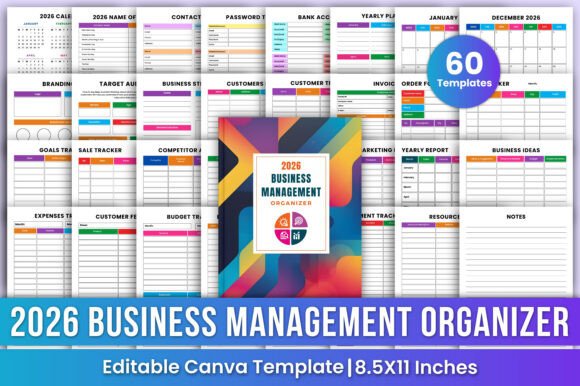
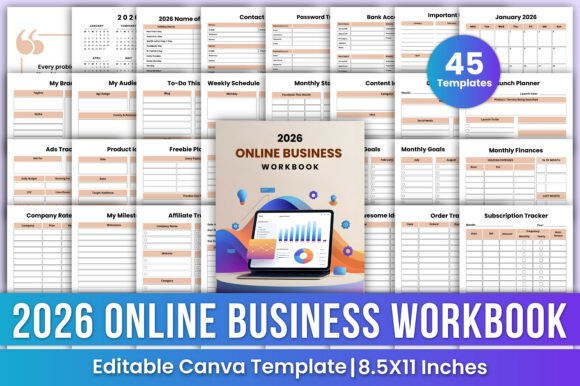
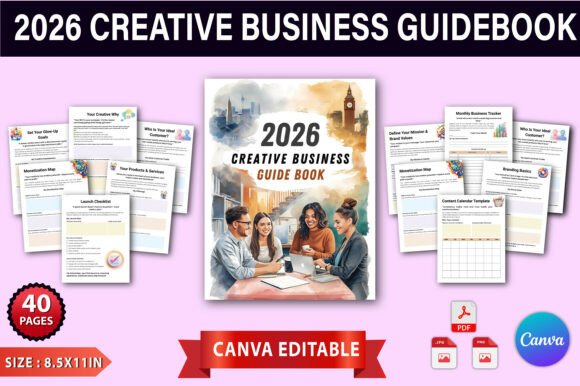
Unlike traditional annual planners anchored to fiscal quarters or tax deadlines, the 2026 Creative Business Guidebook structures time around creative cycles: incubation, iteration, launch, reflection. Its Monthly Business Tracker doesn’t just log income and expenses — it pairs financial data with qualitative inputs like client feedback summaries and personal energy levels. A graphic designer might note in March: “$4,200 income (3 branding packages), but fatigue high after back-to-back revisions; adjusted scope language in April contracts.” That linkage — between numbers and narrative — transforms raw data into diagnostic insight.
This rhythm extends into the Marketing Launch Planner. Rather than prescribing generic “post 3x/week” rules, it guides users to map campaigns around natural creative output windows. A ceramicist launching a new glaze series uses the checklist not to schedule Instagram posts, but to align studio production timelines, photo shoot availability, email list segmentation, and local gallery drop-offs — all within a single visual grid. The result is marketing that feels organic, not outsourced.
From Self-Awareness to Strategic Leverage
Creative businesses often stall not from lack of skill, but from misallocated strength. The Skill Strength Builder avoids superficial “list your top 5 skills” exercises. Instead, it asks users to distinguish between three layers: creative superpowers (e.g., intuitive color harmony), professional competencies (e.g., Adobe Illustrator fluency), and growth edges (e.g., contract negotiation). A writer might realize their superpower is empathetic storytelling — which then informs how they position coaching services (not just “writing edits,” but “helping founders articulate their mission with emotional resonance”). This reframing turns introspection into positioning strategy.
Similarly, the Brand Development Toolkit treats identity as a living system, not a static logo. It moves beyond mood boards to explore tonal consistency across touchpoints: How does your voice shift in a client proposal versus a Patreon update? Which values surface most authentically in your packaging copy versus your workshop facilitation style? One illustrator using the Guidebook discovered her core value of “generative play” was inconsistently expressed — joyful in social bios, overly formal in invoices. Adjusting invoice language to include playful, warm sign-offs increased client retention by 22% over six months, per her tracker data.
Pricing as Philosophy, Not Arithmetic
The Monetization Pricing Planner stands apart by anchoring numbers in purpose. It begins not with competitor research or hourly math, but with questions like: “What does fair compensation mean when your work supports community healing?” or “How does your pricing reflect the time invested in research, not just execution?” This grounds decisions in ethics and sustainability, not scarcity or comparison.
Worksheets walk users through layered models: service tiers calibrated to client capacity (e.g., a “coaching sprint” for solopreneurs vs. “team immersion” for studios), digital product bundles priced by perceived transformation (“Clarity Kit” vs. “Brand Audit PDF”), and physical goods valued for craft labor and material rarity. A textile artist used this framework to shift from flat-rate commissions to a hybrid model — base fee + “pattern archive access” add-on — increasing average order value by 38% while reducing revision requests, because clients felt invested in the broader creative ecosystem.
Vision Mapping That Avoids Vague Aspirations
“Vision boards” often fail because they visualize outcomes without mapping pathways. The Goal Setting Vision Mapping section uses nested horizons: the 5-year “North Star” (e.g., “publish illustrated memoir on creative resilience”), the 18-month “Anchor Milestone” (e.g., “complete manuscript + secure literary agent”), and the 90-day “Traction Sprints” (e.g., “write 3 chapters + host 2 live readings for feedback”). Crucially, each horizon includes a “Reality Check” column: constraints, dependencies, and non-negotiable boundaries (e.g., “max 15 hrs/week writing; require childcare coverage Tues/Thurs”). This prevents burnout-driven abandonment — a common cause of unrealized creative ambition.
Reflection as Operational Infrastructure
Many planners treat reflection as an afterthought — a final journal page, optional and sentimental. In the 2026 Creative Business Guidebook, Reflection & Motivation Pages are structural pillars. They’re placed after every major section (post-pricing exercise, post-launch plan) and include targeted prompts: “What assumption did this process challenge?” “Which small win revealed an unexpected strength?” “What boundary held firm — and what needs reinforcing?”
This transforms reflection from self-help ritual into quality control. A composer using the Guidebook noted recurring friction in collaboration agreements. Her reflection pages revealed a pattern: she consistently deferred to directors’ timelines, even when it compromised sound design integrity. That insight led directly to revising her contract template — adding a “creative review window” clause — which reduced scope creep by 70% in Q1 2025.
Who Benefits Beyond the Obvious?
While artists, writers, designers, and makers are the primary audience, the Guidebook’s architecture serves wider constituencies:
- Educators use the Skill Strength Builder to scaffold student self-assessment in capstone courses, moving beyond rubrics to metacognitive awareness.
- Researchers studying creative labor cite its Monthly Business Tracker as a rare source of longitudinal, self-reported data on income volatility and workflow adaptation.
- Hobbyists transitioning to semi-pro rely on the Vision Mapping to test viability before quitting day jobs — one photographer used the 90-day sprints to validate demand for portrait sessions before investing in studio lighting.
- Business owners managing creative teams adapt the Brand Development Toolkit to align freelance contributors with company voice, reducing onboarding time by standardizing tone benchmarks.
Practical Considerations for Real-World Use
The Guidebook’s effectiveness depends less on perfection and more on consistent, low-friction engagement. Users report highest adherence when they:
- Designate one 20-minute weekly slot — not for “catching up,” but for reviewing the prior week’s tracker and previewing next week’s traction sprint.
- Use the blank margins for rapid notes during calls or client meetings, then transfer key insights to structured sections later.
- Treat the Reflection Pages as confidential — no sharing, no editing — preserving psychological safety for honest assessment.
It’s not meant to replace accounting software or project management tools. Instead, it functions as the central nervous system: synthesizing inputs from QuickBooks, Trello, and spontaneous ideas jotted on napkins into coherent strategy. One UX designer described it as “the bridge between my spreadsheet brain and my sketchbook heart.”
Looking Ahead: Why 2026 Matters Now
The year 2026 isn’t arbitrary. It reflects a deliberate pause point in the accelerating convergence of AI tools, platform volatility, and shifting audience expectations. Creators can no longer rely on algorithmic luck or legacy channels. Sustainability now demands intentionality at every layer — from how you define value to how you protect creative energy. The 2026 Creative Business Guidebook doesn’t predict the future; it equips users to navigate uncertainty with grounded clarity. Its strength lies in refusing to separate the logistical from the lyrical — because in creative enterprise, the most resilient businesses are those where strategy and soul are written on the same page.