The Magic of Kindness: Why Small Acts Spark Big Change in Children’s Hearts and Homes
“The Magic of Kindness” isn’t just a charming bedtime story—it’s a gentle, research-backed invitation to nurture empathy from the earliest years. At its heart lies a simple yet profound truth: kindness is not passive goodwill; it’s an active, observable, teachable skill—one that shapes brain development, strengthens relationships, and builds resilient communities. For parents, educators, and caregivers seeking meaningful ways to instill compassion in children ages 4–8, this KDP picture book offers more than sweet illustrations and animal friends—it delivers a practical, joyful framework for emotional literacy.
What Is the “Magic” in Kindness—Really?
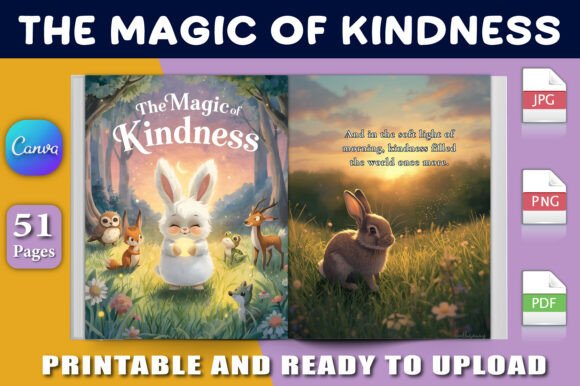
The word “magic” may evoke sparkles and spells—but in child development science, it refers to something equally wondrous: neuroplastic change triggered by positive social interaction. When Bella Bunny helps Oliver Owl find his lost spectacles, Freddie Fox cross the brook, or Lily Frog calm her nerves before her first lily-pad recital, young readers don’t just follow a plot—they witness kindness as behavior, intention, and impact.
This “magic” manifests in three measurable ways:
- Emotional resonance: Mirror neurons fire when children see Bella pause, listen, and act—helping them internalize caring responses as natural, not exceptional.
- Behavioral modeling: Each act is concrete, age-appropriate, and replicable (“I can share my snack,” “I can say ‘Are you okay?’”), making kindness feel accessible—not abstract or overwhelming.
- Environmental reinforcement: The glowing meadow imagery isn’t just poetic—it mirrors real-world findings: classrooms and homes where kindness is named, celebrated, and practiced report lower conflict, higher engagement, and improved well-being.
Why Kindness Education Matters More Than Ever
In a world of rapid digital connection and increasing social fragmentation, children face unique emotional challenges. Studies from the Harvard Graduate School of Education show that over 80% of youth rank achievement and happiness above caring for others—yet those who regularly practice empathy demonstrate stronger academic performance, better conflict-resolution skills, and greater long-term life satisfaction.
“The Magic of Kindness” meets this need with quiet precision. It avoids moral lecturing. Instead, it embeds lessons in rhythm, repetition, and relational warmth—mirroring how young brains learn best: through story, sensory-rich imagery (soft watercolor meadows, expressive animal faces), and predictable emotional arcs. The gentle cadence of phrases like “Bella’s heart hummed, soft and true—kindness made the whole world glow anew” supports language development while reinforcing prosocial values.
How It Fits Into Real-Life Learning
This isn’t just for bedtime. Educators use “The Magic of Kindness” across settings—with tangible results:
- Classroom Community Building: Teachers pair each animal friend with a “Kindness Role” (e.g., “Oliver Owl = Listening Buddy,” “Daisy Deer = Encouragement Keeper”). Students earn glow-sticker badges—not for perfection, but for noticing and naming kind moments.
- Social-Emotional Learning (SEL) Integration: Aligned with CASEL’s five core competencies—especially self-awareness and responsible decision-making—the book sparks discussions like, “When did you feel seen like Lily Frog?” or “What helped Freddie Fox feel safe?”
- Home Rituals: Families create “Glow Jars”—where children draw or dictate one kind act they did or witnessed each day. Over time, the jar fills with light-colored paper strips, visually reinforcing accumulation and agency.
Dispelling Common Misconceptions About Teaching Kindness
Many well-intentioned adults assume kindness is either “innate” or “too vague to teach.” Neither is true—and “The Magic of Kindness” quietly corrects both myths.
✅ Misconception: “Kindness is just being nice.”
Reality: Niceness often prioritizes harmony over honesty; kindness centers respect, courage, and care—even when it’s hard. Bella doesn’t ignore Freddie Fox’s fear; she stays beside him until he feels steady. That’s empathic bravery—not mere politeness.
✅ Misconception: “Young kids are too self-centered to understand kindness.”
Reality: Developmental psychology confirms that children as young as 18 months show spontaneous helping behaviors. What they need isn’t less instruction—but better scaffolding: clear language (“You shared your crayon—that helped Sam finish his drawing”), consistent modeling, and space to practice without shame.
✅ Misconception: “Focusing on kindness takes time away from ‘real’ learning.”
Reality: Neuroscience shows that emotional safety is the foundation for cognitive growth. A calm, connected nervous system learns faster, retains more, and engages deeply. Kindness isn’t a detour from academics—it’s the soil in which literacy, numeracy, and critical thinking take root.
More Than a Book: A Gateway to Everyday Magic
What makes “The Magic of Kindness” especially powerful is its intentional design for extension. Its nature-themed setting—Sunny Meadow—isn’t decorative. It invites outdoor exploration: spotting real frogs, listening for owls, sketching deer tracks. This bridges storytime with ecological awareness and sensory grounding—key tools for reducing anxiety and building presence.
Its animal cast serves another vital function: diversity without labels. Oliver Owl wears glasses and reads maps. Lily Frog has visible braces on her teeth. Daisy Deer moves with a subtle, graceful limp. These details aren’t highlighted as “problems to fix”—they’re simply part of who these characters are. In doing so, the book models inclusive belonging: kindness isn’t about erasing difference, but honoring it with attention and care.
Practical Ways to Deepen the Magic Beyond the Page
- Create a “Kindness Compass”: Draw a simple circle divided into four parts—“Listen,” “Help,” “Include,” “Encourage.” Use it during family meetings or morning circles to set daily intentions.
- Try “Kindness Mapping”: Walk around your neighborhood together. Mark places where kindness lives—a neighbor’s garden shared with passersby, a library book drop, a bench with a “Take what you need, leave what you can” basket.
- Read Aloud with Pauses: Stop at key moments (“Bella saw Freddie’s paws shaking…”) and ask, “What do you think she felt? What might you do?” This builds perspective-taking muscle.
Final Thought: Kindness Is Not Soft—It’s Strategic
In leadership training, engineering ethics, healthcare communication, and AI design—kindness is increasingly recognized not as sentimentality, but as systems intelligence. It anticipates needs, reduces friction, fosters trust, and prevents burnout. When we read “The Magic of Kindness” with children, we’re not just tucking them in—we’re equipping them with foundational human infrastructure.
So yes, the meadow glows. Yes, the animals smile. But the real magic? It’s already inside every child—and every adult willing to name it, nurture it, and never underestimate its quiet, radiant power.
Looking for classroom-ready discussion questions, printable kindness cards, or a free “Sunny Meadow Activity Pack”? Visit the official companion site for downloadable resources designed to bring the magic off the page—and into everyday life.