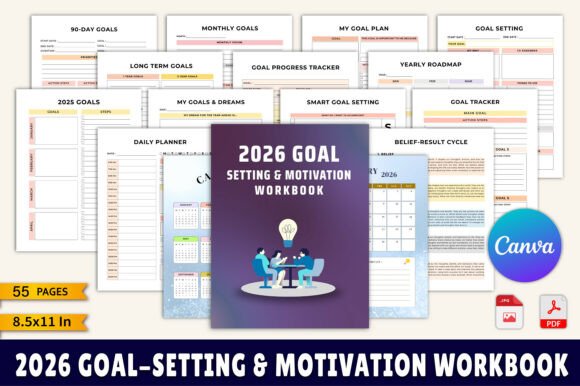
2026 Goal-Setting Motivation Workbook
If you’ve ever stared at a blank calendar in January, scribbled “get healthier” or “launch side hustle” in a notebook, then watched momentum fade by March—you’re not falling short. You’re missing a system built for real life. The 2026 Goal-Setting Motivation Workbook isn’t another glossy planner promising overnight transformation. It’s a grounded, flexible companion designed for the messy, beautiful reality of growth: the late-night doubt, the unexpected detours, the small wins that rarely make headlines—but change everything.
When Life Happens (and Goals Need to Breathe)
This workbook shines brightest when your plans collide with actual living. Think of a teacher juggling lesson prep, IEP meetings, and family responsibilities—she uses the Monthly Intention Pages not to cram more in, but to ask: What one classroom goal feels energizing this month—not exhausting? Or the new parent who swaps rigid “lose 20 lbs by March” for a 30-Day Habit Tracker focused on 10-minute walks and hydration—tracking consistency, not just scale numbers. The structure adapts instead of demanding perfection.
Freelancers and solopreneurs face shifting priorities daily. One week it’s client deadlines; the next, it’s updating contracts or learning a new tool. The Weekly Planner Layouts include dedicated “Focus Blocks” and “Flex Time” slots—so when an urgent revision request lands Tuesday afternoon, they don’t scrap the whole week. They shift, reschedule, and keep their SMART Goal Planning sheet intact—because “revise website copy” stays measurable (“update homepage + 3 service pages by Feb 15”) even when the timeline bends.
For the Quiet Achievers—and the Loudly Stuck
Not everyone thrives on public accountability or viral challenge culture. The 2026 Goal-Setting Motivation Workbook meets people where they are. A software engineer quietly aiming for a leadership role uses the Belief-Result Cycle Worksheets to unpack thoughts like “I’m not a natural leader”—then traces how that belief shows up in missed speaking opportunities or deferred credit. She doesn’t need a podcast or mastermind; she needs space to name the inner script—and rewrite it slowly, with evidence.
Meanwhile, someone recovering from burnout might skip the “5 AM routine” pressure entirely. Instead, they lean into the Daily Affirmations & Gratitude Prompts, choosing gentle anchors like “My worth isn’t tied to output” or “Today, rest counts as progress.” The Vision Board Dream Mapping section becomes less about aspirational aesthetics and more about tactile grounding—cutting out images of quiet forests or handwritten notes, not job titles—reconnecting with values before goals.
Real Workplaces, Real Gaps
In corporate settings, annual reviews often feel disconnected from day-to-day work. Teams using the 2026 Goal-Setting Motivation Workbook (individually or in aligned cohorts) bridge that gap. A marketing coordinator aligns her personal development goal (“lead one cross-departmental campaign”) with her team’s Q2 objective—then uses the Progress Trackers to log not just tasks completed, but skills practiced (“facilitated kickoff call,” “delegated design feedback”). Her manager sees growth in action—not just a checkbox.
Nonprofit staff juggling grant reporting, community outreach, and emotional labor find relief in the Action Reflection Pages. Instead of asking “Did I do enough?”, they reflect: “What energy did this project drain—and what replenished me?” That insight informs realistic goal-setting for 2026: maybe “secure two new community partners” replaces “host five events,” honoring bandwidth without sacrificing impact.
What to Consider Before You Begin
The 2026 Goal-Setting Motivation Workbook works best when matched to your rhythm—not forced into someone else’s. If you dread color-coding or spend more time decorating than reflecting, the Dot Note Pages and clean Canva-editable layouts let you keep it simple: bullet points, quick sketches, voice-to-text notes pasted in. No aesthetic pressure.
It’s intentionally *not* a replacement for therapy, financial advising, or medical care. If your goal involves deep-seated anxiety around failure, complex debt restructuring, or chronic health management, pair the workbook with professional support—the Motivation Mindset Tools complement expertise; they don’t substitute for it.
Also know: the editable Canva files shine for digital users—but if you prefer pen-on-paper, print the PDF version and use a fine-tip marker. The Annual Planner’s undated format means you can start anytime (yes, even in April). And while the 30-Day Challenge Tracker builds consistency, it’s designed for iteration: finish one habit, pause, reflect, then choose the next—not chain yourself to back-to-back challenges.
Where It Goes Deeper Than a Standard Planner
Most planners help you schedule. This one helps you choose. The Vision Board Dream Mapping isn’t about wishful collage—it guides you to separate “lifestyle dreams” (a home office with natural light) from “identity goals” (being known as a thoughtful collaborator) and “contribution goals” (mentoring one junior colleague). That clarity prevents misalignment: saying “yes” to a high-profile project that drains your energy because it looks impressive—but contradicts your core value of sustainable pace.
The Progress Trackers avoid vague “on track/off track” labels. Instead, they prompt: “What’s one thing that moved forward—even slightly?” and “What support would make the next step easier?” That subtle shift—from judgment to curiosity—keeps motivation alive during plateaus.
Who Might Find It Less Fit (and What to Do Instead)
If your current priority is crisis management—like navigating sudden job loss, acute illness, or caregiving emergencies—the workbook’s reflective depth may feel overwhelming. In those moments, simplicity wins: try using just the Daily Affirmations printed on sticky notes, or the Dot Note Pages as pure brain-dump space—no structure required. Return to the full system when stability returns.
Teams needing real-time collaboration might supplement the workbook with shared digital tools (like Notion or Trello), using the 2026 Goal-Setting Motivation Workbook for individual clarity first—then syncing key goals outward. It’s a foundation, not a silo.
Ultimately, the 2026 Goal-Setting Motivation Workbook succeeds because it assumes you’re already capable. It doesn’t sell hustle—it honors rhythm. It doesn’t demand radical reinvention—it supports steady, self-aware evolution. Whether you’re launching a bakery, healing after loss, studying for exams, or simply craving more presence in ordinary days, it offers not a map to someone else’s destination—but compass points calibrated to your own voice, values, and version of success.