2026 Burnout Recovery Workbook
If you’ve ever stared at your calendar and felt dread instead of direction—if “just one more deadline” has become your default mantra—then the 2026 Burnout Recovery Workbook isn’t just another planner. It’s a grounded, practical response to what so many adults actually experience: chronic mental fatigue that sneaks up between meetings, late-night emails, caregiving shifts, or creative blocks.
This isn’t a quick-fix journal or a vague “self-care checklist.” It’s a guided, year-long recovery system designed for people who know they need structure—not inspiration—to rebuild resilience. Whether you’re a freelance graphic designer juggling five clients, a teacher planning lessons while managing student trauma, a small business owner tracking inventory *and* burnout symptoms, or a parent trying to stay present after back-to-back Zoom calls—the 2026 Burnout Recovery Workbook meets you where your energy is low and your to-do list is long.
When and Where This Workbook Fits Into Real Life
You don’t need a dramatic crisis to use it. In fact, most people reach for the 2026 Burnout Recovery Workbook during quieter moments—like Sunday evenings when motivation feels thin, or midweek mornings when coffee stops working. That’s by design. Its layout supports micro-moments of reflection: five minutes with a breathing exercise before a team call, ten minutes logging mood and sleep after the kids are in bed, or 15 focused minutes setting a single SMART goal before launching into work mode.
For creators and educators, it replaces scattered notes in Notes apps or sticky tabs on laptops. A blogger might use the self-reflection worksheets to identify why certain topics drain them—or energize them—so they can adjust content strategy without guilt. An educator could track emotional capacity alongside lesson prep, spotting patterns like “I feel overwhelmed every Thursday after IEP meetings,” then using the boundary-setting prompts to protect that time.
Freelancers and solopreneurs often struggle with blurred lines between rest and work. The 2026 Burnout Recovery Workbook helps make those boundaries visible—through habit trackers that log screen time vs. movement, weekly gratitude pages that ground attention outside client feedback, and vision dream boards that reconnect daily tasks to deeper purpose (“Why did I start this business again?”).
How Features Translate to Real Outcomes
The 2026 calendar planner pages aren’t just for scheduling—they’re diagnostic tools. When you see three “low-energy” days clustered before a major launch, you start planning buffer time. When you notice water intake drops during travel weeks, you prep hydration reminders ahead of time. It’s not about perfection—it’s about noticing patterns *before* they become crises.
The stress management techniques—deep breathing guides, mindfulness scripts, and grounding prompts—are written for people who’ve tried meditation apps and quit after day three. These are short, concrete, and tied to real triggers: “Try this 60-second breath before replying to an urgent email,” or “Use this body scan if your shoulders are tight during video calls.” No jargon. No assumptions about quiet space or silence.
The self-care wellness trackers (mood, sleep, water, fitness) work best when used selectively—not every day, but consistently enough to spot trends. A marketer recovering from adrenal fatigue might track only sleep and caffeine for two weeks, then add mood once she notices her irritability spikes after afternoon meetings. Flexibility matters more than completeness.
Gratitude journaling here avoids clichés. Instead of “list three things you’re grateful for,” prompts ask: “What small thing today felt genuinely easy?” or “Who made something harder feel lighter—and how?” That specificity builds authentic optimism, not forced positivity.
Who Benefits—and How Their Needs Shape Use
A small business owner might prioritize the behavior & medication trackers—not because they’re on prescriptions, but to monitor how consistent routines (e.g., morning walks, screen-free evenings) impact focus and decision fatigue. They’ll likely skip the dream board early on and return to it in Q2, once baseline energy stabilizes.
A nurse or social worker may lean heavily on the anxiety & emotional health tools—logging triggers like “post-shift debriefs” or “charting deadlines,” then testing coping strategies side-by-side. The editable Canva link becomes essential here: they customize templates to match workplace terminology or shift schedules.
Hobbyists and lifelong learners use the goal-setting section differently—not for KPIs, but for “creative sustainability”: “Practice guitar 12 minutes twice a week,” tracked alongside mood, so they learn whether music lifts energy or adds pressure depending on the day.
What to Consider Before You Start
This workbook works best when treated as a tool—not a test. You don’t have to fill every page. Skipping a week? Normal. Repeating the same breathing exercise for a month? Effective. Using only three sections consistently? Still progress.
It’s also not a replacement for clinical support. If anxiety, exhaustion, or emotional numbness persist despite consistent use, that’s valuable data—not failure. The symptom tracker helps articulate what’s happening, making conversations with therapists or doctors more precise.
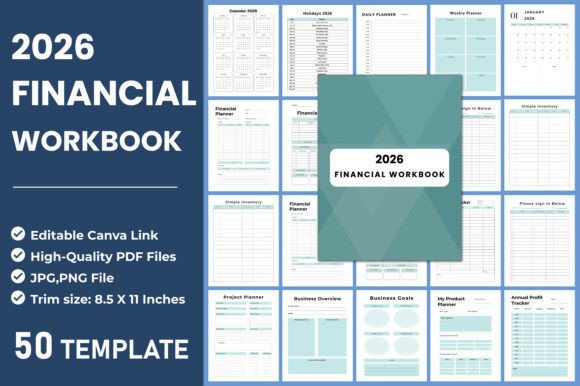
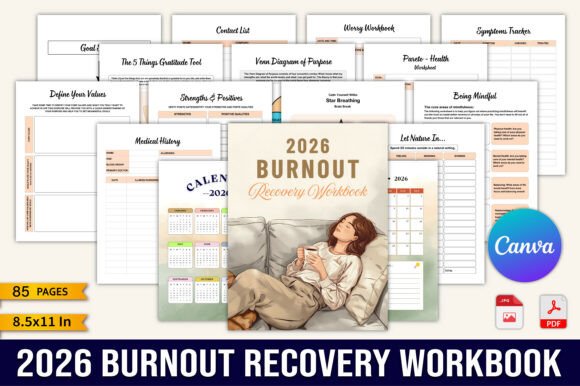
The editable Canva link is a strength—but requires basic comfort with digital tools. If you prefer printing and handwriting, the high-quality PDF files are optimized for crisp ink and clean margins. All 85 templates fit standard 8.5×11 printers, and many users print only the pages they’ll use that week (e.g., Monday’s mood + water tracker, Wednesday’s reflection prompt, Friday’s gratitude wrap-up).
Finally, timing matters. Starting in January isn’t required. Many begin in March after holiday recovery, or July to reset mid-year momentum. The 2026 date isn’t rigid—it’s scaffolding. You’re not behind if you start in April. You’re meeting yourself where you are.
Why This Feels Different Than Other Planners
Burnout isn’t solved with better time management alone. It’s eased through repeated, gentle choices that reinforce safety, agency, and self-trust. The 2026 Burnout Recovery Workbook builds those choices into its architecture: the blank space after each reflection prompt invites honesty, not performance; the progress trackers celebrate consistency over speed; even the vision dream board asks “What does rest look like *this year*?”—not “What do you want in five years?”
That’s the quiet power of it. It doesn’t ask you to hustle your way out of exhaustion. It gives you permission—and practical steps—to recover, one intentional, unglamorous, deeply human moment at a time.