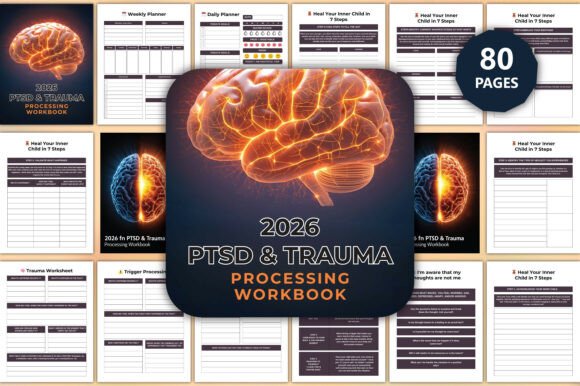
2026 PTSD Trauma Processing Workbook
The 2026 PTSD Trauma Processing Workbook isn’t a quick-fix tool—it’s a structured, psychology-informed process for integrating healing into daily life. Designed for adults who juggle professional responsibilities, creative output, caregiving, or personal growth while managing the lingering effects of trauma, grief, anxiety, or emotional dysregulation, this workbook meets users where they are: in the middle of real-world demands. It doesn’t ask you to pause your life to begin healing. Instead, it builds healing into the rhythm of your existing workflow—whether that’s preparing for a high-stakes presentation, launching a small business, supporting a loved one through crisis, or simply showing up consistently for yourself.
How It Fits Into Real-Life Workflow Cycles
Most self-help tools assume healing happens in isolation—on weekends, during retreats, or after “everything else is done.” The 2026 PTSD Trauma Processing Workbook operates differently. Its 2026 full-year calendar daily planner integrates seamlessly with how people already plan: using digital calendars, task managers (like Todoist or Notion), or analog bullet journals. You don’t need to choose between productivity and healing. A morning review of your daily planner page can include grounding before a team meeting; a midday trigger response tracker entry can inform how you adjust your afternoon workload; an evening inner child reflection becomes part of your wind-down ritual—not an extra task, but a recalibration.
This compatibility extends to clinical support. If you’re in therapy, the 2026 PTSD Trauma Processing Workbook serves as a shared reference point: Therapy Progress Notes pages let you track insights across sessions, note patterns your clinician may highlight, and prepare focused questions. Medical Therapy Trackers—Medication Tracker, Doctor Visits, and symptom logs—align with electronic health record workflows, making appointments more efficient and communication with providers more precise. For those coordinating care across multiple professionals (e.g., psychiatrist, therapist, primary care), this consistency reduces cognitive load and improves continuity.
Practical Integration Across Common Scenarios
Before a major project or decision: Use the Trauma Identification Worksheets not to dredge up pain, but to map emotional thresholds. What conditions make you feel unsafe or overwhelmed? How does fatigue or unpredictability affect your capacity? Mapping these in advance helps you design realistic timelines, buffer zones, and delegation strategies—especially valuable for entrepreneurs launching products or educators planning curriculum rollouts.
During creative work: Writers, designers, and content creators often encounter blocks rooted in shame, perfectionism, or fear of criticism—symptoms tied to unresolved trauma. The Self-Awareness Reflection Pages offer low-pressure space to name what’s arising without judgment. Pausing for a Heart Breathing Exercise before drafting sensitive material—or reviewing a Worry Coping Card when imposter thoughts surface—creates micro-interventions that sustain momentum without suppressing emotion.
After a setback or transition: Whether it’s a layoff, relocation, loss, or pivot in business direction, grief and disorientation often arrive quietly. The workbook’s grief-aligned prompts and Inner Child Healing 7-Step Program provide scaffolding—not to “get over it,” but to honor what changed and re-anchor identity. Re-parenting exercises (e.g., writing compassionate letters to your younger self) help rebuild internal safety when external structures shift.
Organization That Supports Consistency, Not Perfection
Usability matters most when emotional bandwidth is limited. The 2026 PTSD Trauma Processing Workbook avoids dense text or abstract theory. Each section uses gentle, actionable language and clear visual hierarchy: worksheets have defined spaces for short answers, checkboxes, and freeform notes—not blank pages that invite avoidance. Trigger Response Trackers use simple grids to log date, situation, physical sensation, emotion, and coping strategy used—making pattern recognition possible even on low-energy days.
Its physical design supports long-term use: lay-flat binding, thick paper for pen or pencil, and intuitive tabbed sections mean you can open directly to “Coping Skills Library” during a commute or flip to “Inner Child Healing” before bed—no hunting, no friction. Unlike apps that require login, updates, or notifications, this is a tactile, always-on resource. That reliability builds habit strength: studies show consistent journaling improves emotional regulation *only* when the barrier to entry stays low. This workbook lowers it intentionally.
Workflow Synergy With Other Tools
The 2026 PTSD Trauma Processing Workbook works best when treated as a core node—not a standalone island. Here’s how it connects:
- With digital tools: Scan completed Tracker pages weekly into cloud storage (e.g., Google Drive or Obsidian), tagging by theme (“sleep,” “work triggers,” “inner child”). Use those tags to spot trends over months—not just days.
- With habit trackers: Link entries to existing routines. Example: After logging morning coffee, complete one Self-Love Emotional Growth prompt. Pairing with an established cue increases adherence.
- With peer support: Share anonymized insights (e.g., “I noticed my anxiety spikes before client calls—so I now prep grounding phrases in advance”) in accountability groups or supervision circles. The workbook gives concrete language instead of vague “I’m stressed.”
- With boundary-setting practices: Use Trigger Response Tracker data to identify recurring stressors—and then draft scripts for saying no, delegating, or rescheduling. Healing isn’t passive; it informs action.
What Makes It Sustainable Over Time
Many trauma journals fade after a few weeks because they demand too much too soon—long essays, daily affirmations that feel hollow, or rigid schedules. The 2026 PTSD Trauma Processing Workbook builds sustainability through variation and permission: some days call for a single sentence in the Daily Planner; others allow full exploration in the Inner Child section. There’s no “missed day” penalty—just a clean page waiting tomorrow.
It also anticipates change. Because it spans all of 2026, it accommodates shifting needs: early-year entries might focus on stabilization; mid-year, on reclaiming joy or agency; late-year, on integration and forward motion. That longitudinal structure mirrors how healing actually unfolds—not linearly, but cyclically, with layers deepening over time.
For professionals who manage teams or teach others, the workbook doubles as a reference for empathetic leadership. Understanding your own triggers and coping styles makes it easier to recognize them in colleagues—and design workflows that reduce collective burnout. When psychological safety starts with individual tools like this, it scales.
Getting Started Without Overwhelm
You don’t need to begin on January 1st—or even open every section at once. Start where your nervous system feels safest:
- Flip to the Coping Skills Library and try one Heart Breathing Exercise before your next video call.
- Use the Trigger Response Tracker for just three days—notice what arises without analyzing it.
- Write one sentence in a Self-Awareness Reflection Page: “Right now, I need…”
That’s enough. The power lies not in completion, but in repetition with presence. Over weeks, those small acts accumulate into new neural pathways—less reactivity, more choice, deeper self-trust. And because it’s built for 2026, it grows with you, season by season, challenge by challenge, insight by insight.