2026 Couples Therapy Workbook 💞 KDP
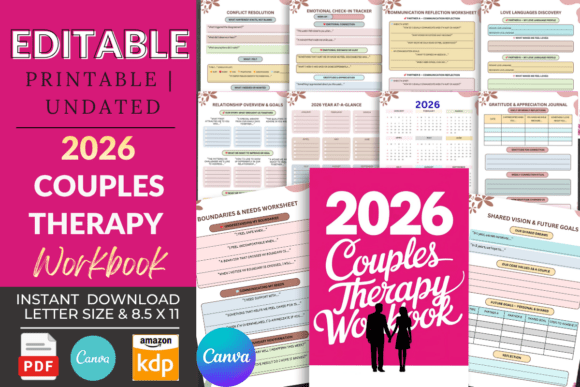
Relationships don’t thrive on intention alone—they grow through consistent, intentional practice. The 2026 Couples Therapy Workbook 💞 KDP meets that need with grounded structure and compassionate design. More than a collection of prompts, it’s a 120-page guided companion built for real couples navigating real life: the quiet misunderstandings, the unspoken needs, the slow erosion—or joyful rekindling—of emotional connection. Designed in with-bleed format for professional printing, it bridges therapeutic insight and everyday usability.
Why This Workbook Stands Apart
Unlike generic relationship journals or overly clinical manuals, the 2026 Couples Therapy Workbook 💞 KDP balances evidence-informed frameworks with warm, accessible language. It doesn’t assume prior therapy experience—and it doesn’t talk down to readers who’ve been in counseling for years. Its strength lies in integration: each section supports the others. For example, completing the Emotional Check-In Pages naturally informs how partners approach the Conflict Resolution Worksheets. Tracking Love Language patterns helps personalize Intimacy Builder Prompts. Nothing exists in isolation.
What’s Inside—and Why It Matters
- Relationship Vision Pages: Not just “where do we want to be?” but “what values anchor us there?” These pages help couples co-create a shared compass—not a rigid destination. One therapist reported using them with premarital clients to uncover misalignments around finances, family roles, and growth mindset—before vows were exchanged.
- Communication Reflection Worksheets: These go beyond “I feel…” statements. They guide partners through identifying listening habits (e.g., problem-solving vs. validating), noticing nonverbal cues, and naming assumptions before they escalate into arguments.
- Love Language Tracker: Updated for 2026, this version includes space for seasonal shifts—because how someone receives love may change during job loss, new parenthood, or caregiving stress. It also invites reflection on *why* certain expressions resonate more deeply at different times.
- Emotional Check-In Pages: Designed for 5–7 minutes, not an hour. Each entry asks: What feeling is strongest right now? What triggered it? What do I need—even if I’m not ready to ask? Over time, these build emotional literacy without demanding perfection.
- Conflict Resolution Worksheets: Uses a gentle, stepwise model: Pause → Name the Need → Share Without Blame → Co-Create One Small Shift. No jargon. No forced apologies. Just clarity and agency.
- Trust Boundaries Tracker: Especially valuable after breaches—big or subtle. Helps partners distinguish between boundaries (non-negotiables tied to safety and respect) and preferences (flexible wishes). Includes prompts for renegotiation as life evolves.
- Intimacy Builder Prompts: Focuses on micro-moments: shared silence that feels safe, recalling a time you felt truly seen, naming one thing you admire about your partner’s resilience. Intimacy isn’t always physical—it’s often found in witnessed authenticity.
- Weekly Couple Planner: Integrates logistics *and* emotional labor. Blocks for “shared responsibility review,” “uninterrupted 20-minute check-in,” and even “gratitude exchange”—not just date night reminders.
Who Benefits Most—and When
The 2026 Couples Therapy Workbook 💞 KDP serves diverse needs—but its greatest impact appears when used with realistic expectations:
- Couples in early recovery from disconnection (e.g., post-pandemic distance, post-baby fatigue) use it to rebuild rhythm—not fix everything overnight.
- Premarital couples appreciate its non-prescriptive tone. It surfaces differences gently, without framing them as red flags—just data points for deeper conversation.
- Therapists and coaches integrate select pages into sessions or assign as between-session work. Its clean layout and clear instructions reduce client confusion and increase follow-through.
- Self-guided learners (including those with limited access to care) value its scaffolding: no therapist required to begin, though it complements professional support beautifully.
It’s less effective for couples in active crisis—such as ongoing abuse, addiction without treatment, or severe untreated mental health conditions. In those cases, the workbook can be a helpful adjunct *after* safety and stabilization are prioritized—but never a substitute for urgent clinical care.
Real-World Use Cases
A small business owner and their spouse used the Weekly Couple Planner to carve out “no-screen Sundays” after months of burnout-driven disengagement. They started with 90 minutes—cooking together while alternating who shares a win and a worry. Within six weeks, they’d reclaimed two full hours weekly, then added a monthly “relationship audit” using the Relationship Reflection Pages.
A couple navigating long-distance adapted the Emotional Check-In Pages into voice-note exchanges. They didn’t share every entry—just one per week, chosen intentionally. Over time, they noticed patterns: one partner’s anxiety spiked before video calls; the other felt unseen when messages went unanswered for >4 hours. That awareness led to new agreements—not fixes, but shared understanding.
A therapist working with neurodivergent couples highlighted the Communication Reflection Worksheets for their concrete, low-assumption structure. Clients appreciated having space to write before speaking—and the option to submit written reflections instead of verbalizing in session.
Practical Considerations for Users
Because the 2026 Couples Therapy Workbook 💞 KDP is designed for print-on-demand (with-bleed format), users should verify printer settings before ordering. Bleed ensures no white edges on trimmed pages—a small detail that impacts perceived professionalism, especially for clinicians offering it as a resource.
While digital versions exist unofficially, the intentional tactile experience matters: flipping physical pages slows cognition, supports memory retention, and reduces screen-related defensiveness. Many couples report greater honesty when writing by hand—even if imperfectly.
There’s no “right pace.” Some complete one section per week; others revisit the Intimacy Builder Prompts daily for a month. The workbook honors autonomy—no deadlines, no grades, no comparison.
What It Doesn’t Promise—and Why That’s a Strength
This isn’t a quick-fix manual. It won’t eliminate conflict, guarantee compatibility, or replace skilled therapy when needed. What it does offer is agency: tools to name what’s happening, pause before reacting, repair small ruptures, and celebrate ordinary moments of connection. Its power lies in repetition—not revelation.
One user wrote: “We didn’t fall back in love—we remembered how to listen like we used to. That changed everything.”
Making It Work for Your Needs
Evaluate fit by asking:
- Is our goal mutual growth—not fixing one person? The workbook assumes partnership, not pathology.
- Can we commit to consistency over intensity? Ten minutes twice weekly yields more than one overwhelmed 90-minute session.
- Are we open to noticing patterns—not just solving problems? Its value multiplies with reflection over time.
If yes, the 2026 Couples Therapy Workbook 💞 KDP becomes more than paper and ink. It becomes a quiet collaborator—one that holds space, asks good questions, and reminds you, again and again, that love is both a feeling and a practiced skill.