2026 Vision Board Ideas Book
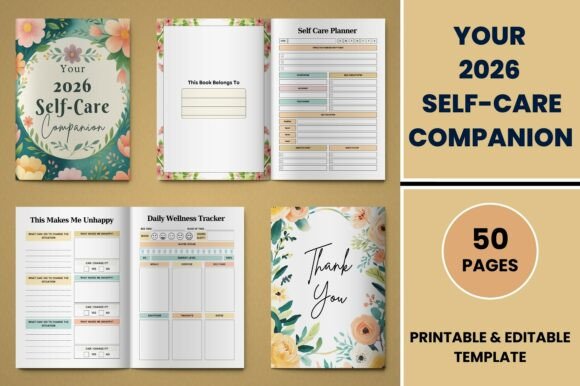
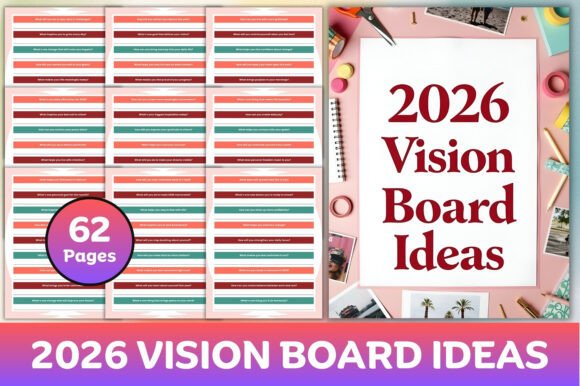
Imagine opening a tool that doesn’t just ask you what you want in 2026—but helps you feel it, name it, and map it with clarity and calm. That’s the quiet power of the 2026 Vision Board Ideas Book. It’s not another generic planner or glossy manifestation journal. It’s a thoughtfully structured 62-page companion built for real people who value intention over inertia—designers sketching new brand directions, entrepreneurs refining their Q1–Q4 rhythm, bloggers planning content aligned with personal growth, or educators preparing reflective goals for the year ahead.
Visually, the book leans into clean, grounded design: ample white space, intuitive layout hierarchy, and consistent typography that supports—not competes with—your thinking. The interior uses a balanced mix of sans serif for prompts (friendly but precise) and subtle serif accents in headings (adding warmth and editorial trust). Nothing feels decorative for decoration’s sake. Every line, margin, and bullet point serves legibility and flow—especially important when you’re handwriting reflections or printing pages for physical vision board assembly.
A Tool Designed for How You Actually Work
This isn’t a passive artifact. It’s built for interaction. The 400 guided prompts aren’t vague affirmations—they’re layered questions that scaffold self-inquiry: “What does ‘abundance’ look like in your workspace this year?” or “Which three habits would quietly reshape your energy by March?” Paired with reflection spaces and a full 2026 yearly calendar, it bridges abstract desire and tangible action. For creatives, that means fewer blank-page freezes and more momentum from day one.
If you’re a small business owner prepping a 2026 product launch or rebrand, the structure helps align internal values with external messaging. If you’re a content creator mapping seasonal themes or audience engagement goals, the gratitude prompts and intentional living sections keep your voice authentic—not algorithm-optimized. Even marketers find value here: using the reflection pages to audit last year’s campaigns not just by metrics, but by resonance and alignment.
Why Print-Ready Design Matters—Especially Now
The 2026 Vision Board Ideas Book ships as print-ready PDF, PNG, and JPG files—all at 300 dpi. That precision matters. Whether you’re printing at home on matte paper for tactile journaling, sending files to a local print shop for bound copies, or uploading directly to KDP for self-publishing, the consistency holds. No blurry lines, no shifted margins, no surprise font substitutions. The 8.5 × 11” size fits standard binders, desk trays, and scanning workflows—practical down to the millimeter.
This level of technical readiness saves hours. Designers don’t waste time adjusting bleed or resizing elements. Publishers avoid last-minute formatting delays before launch. Crafters can cut, collage, and laminate without worrying about pixelation or alignment drift. It’s professional-grade infrastructure wrapped in approachable intent.
How It Fits Into Your Creative Ecosystem
You don’t need to be “into” vision boards to benefit. Think of the 2026 Vision Board Ideas Book as modular design assets for intentionality: use the prompts in team workshops, adapt the reflection questions for client discovery calls, or pull the calendar layout as a base for your own editorial content planner. Bloggers repurpose the gratitude prompts into newsletter prompts. Educators build classroom goal-setting modules from the self-growth sections.
For brand strategists, it’s a case study in tone consistency—how warm yet authoritative language, paired with restrained visual design, builds credibility without coldness. For packaging designers, it demonstrates how interior structure influences perceived value: a well-spaced, readable interior makes even a simple printed book feel premium. And for anyone building a digital course or membership, these pages translate cleanly into printable workbooks—no redesign needed.
Realistic Pairings & Practical Use Cases
Pairing fonts? The interior’s primary sans serif works seamlessly with humanist typefaces like Lato or Open Sans for digital supplements—or with a gentle script (e.g., Pacifico or Dancing Script) for handwritten headers in custom versions. Avoid overly geometric or condensed sans serifs if adding overlays—they’ll clash with the book’s organic pacing.
Readability testing is straightforward: print a sample prompt page at 100% scale, step back three feet, and ask—can you scan and grasp the question’s core in under five seconds? That’s the threshold the 2026 Vision Board Ideas Book meets consistently. Line height, character spacing, and contrast were tuned for both screen reading (on tablets during coffee-shop planning sessions) and ink-on-paper clarity (during early-morning journaling).
Licensing is clear-cut: all included assets are commercial-use ready. No attribution required. Whether you’re bundling it into a coaching package, reselling printed copies at a craft fair, or integrating pages into a paid workshop kit—you’re covered. No legal guesswork, no hidden restrictions.
More Than a Book—A Consistency Anchor
In a world of fragmented tools—apps that demand login, templates that require constant tweaking, journals that leave too much blank—the 2026 Vision Board Ideas Book offers something increasingly rare: continuity. Its structure encourages returning, not restarting. You’ll revisit the same calendar page in January and October, noticing shifts in priorities, energy, or phrasing. That repetition builds self-awareness faster than any single “aha” moment.
For designers, it models how constraint enables creativity: limited visual elements, focused typography, intentional whitespace—all working together to make reflection feel spacious, not sparse. For publishers, it’s proof that simplicity sells—not because it’s minimal, but because it removes friction between idea and action.
Whether you’re manifesting a creative breakthrough, launching a side project, rebuilding routines after life change, or simply wanting to enter 2026 with grounded clarity—the 2026 Vision Board Ideas Book meets you where you are. Not with noise. Not with pressure. But with 62 pages of thoughtful, usable, beautifully engineered space to begin.