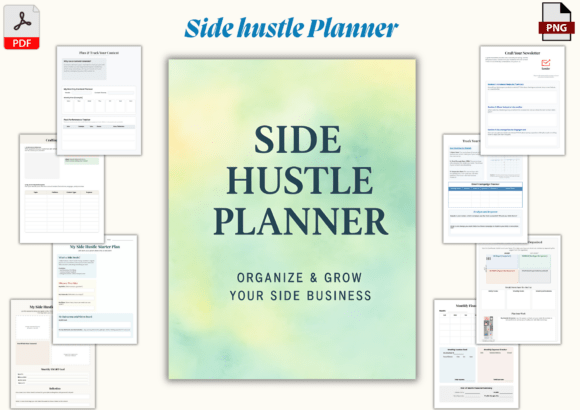
Side Hustle Planner
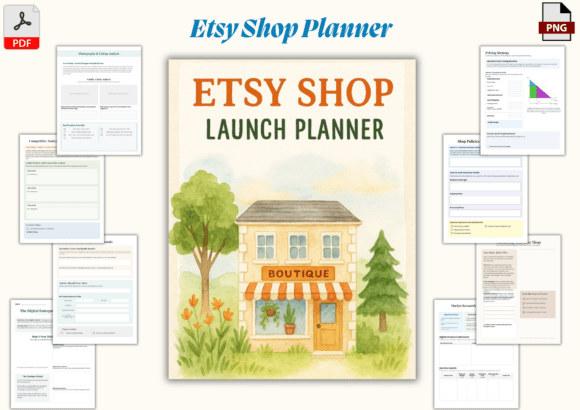
The Side Hustle Planner is a purpose-built digital planning tool designed for individuals building income-generating activities alongside full-time work or other commitments. It’s an 18-page printable resource formatted at 8.5 x 11 inches, delivered as both PDF and PNG files. Its structure supports early-stage business development—not through abstract theory, but through applied templates for goal setting, financial tracking, marketing planning, product development, and reflection.
Unlike general productivity planners or broad business journals, the Side Hustle Planner focuses specifically on the logistical and psychological challenges unique to side ventures: limited time, competing priorities, inconsistent income, and evolving clarity around vision and value. It does not replace accounting software, project management tools, or formal business education—but it complements them by consolidating key planning tasks into a single, undated, low-friction format.
Who Might Benefit Most?
This planner is especially relevant for people who:
- Already have a side hustle idea—or are actively testing one—and need structure to move from intention to action;
- Struggle with consistency due to time constraints and want lightweight systems (not complex workflows) to maintain momentum;
- Prefer visual, tactile planning methods—such as writing goals by hand or filling out worksheets—and find digital tools distracting or less engaging;
- Are freelancers, Etsy sellers, content creators, coaches, or service providers operating independently without team support;
- Value clarity over complexity and respond better to guided prompts than open-ended journaling.
Its emphasis on SMART goals, monthly financial tracking, and marketing planning makes it useful during early validation phases—when testing pricing, refining messaging, or assessing profitability across small batches of sales or projects.
Potential Benefits
Clarity through constraint. With only 18 pages, the Side Hustle Planner avoids overwhelm. Each section serves a defined function—vision boards, income/expense logs, content calendars, product pricing sheets—so users invest time where it matters most.
Flexibility in timing. Because pages are undated, users can begin at any point in their journey—not just January or the start of a fiscal quarter. This lowers the barrier to entry for those who’ve delayed launching due to “waiting for the right time.”
Integration with existing tools. As a printable PDF or PNG, it works alongside digital calendars, spreadsheets, or invoicing platforms. For example, weekly income figures logged manually can later inform quarterly tax estimates or cash flow reviews in Excel.
Behavioral reinforcement. Reflection pages and success trackers encourage regular review cycles—helping users notice patterns (e.g., which marketing efforts yield inquiries, how long tasks actually take), rather than relying on memory or sporadic updates.
Important Considerations and Tradeoffs
The Side Hustle Planner is intentionally minimal. That means it does not include features common in comprehensive business planning tools—such as legal structure guidance, detailed financial forecasting models, customer relationship management (CRM) templates, or integration with banking APIs. Users seeking those capabilities would need to pair it with other resources.
It also assumes a baseline level of business awareness. Someone unfamiliar with terms like “SMART goals,” “customer acquisition cost,” or “content pillars” may need to consult external references while completing certain worksheets. The planner supports execution—but not foundational learning.
Because it’s print-based, it lacks real-time collaboration features or cloud syncing. Teams or co-founders won’t benefit unless they adopt parallel individual use. Likewise, users who prefer typing over handwriting—or rely heavily on search, copy-paste, or auto-calculations—may find the static format limiting.
Finally, while the watercolor design contributes to visual appeal, aesthetics alone don’t drive results. Effectiveness depends on consistent engagement—not ownership. Like any planning tool, its value scales with usage frequency and honest self-assessment.
When Alternatives May Be More Suitable
A different solution may be preferable if you:
- Need deep financial modeling—for instance, multi-year projections, break-even analysis, or scenario planning—where spreadsheet flexibility outweighs guided worksheet structure;
- Operate a regulated or highly technical business (e.g., healthcare consulting, construction contracting) requiring compliance checklists, licensing timelines, or safety documentation;
- Prefer fully digital workflows with automation—such as linking calendar events to task lists, triggering follow-up emails after client onboarding, or pulling live sales data from e-commerce platforms;
- Are working within a team and require shared editing, version control, or permission-based access;
- Are still exploring business ideas without a clear direction—where broader ideation frameworks (e.g., lean canvas, business model generation) may offer more diagnostic value before committing to execution-focused tools.
Making a Practical Decision
To assess whether the Side Hustle Planner fits your current needs, consider these questions:
- What’s your biggest bottleneck right now? If it’s unclear priorities, scattered to-do lists, or inconsistent revenue tracking, the planner’s structured prompts may help. If it’s lack of market demand, technical skills, or capital, no planner will resolve that directly.
- How do you currently plan and reflect? If you already use paper notebooks or printed templates—and find them helpful—the Side Hustle Planner offers curated, tested versions of those same functions. If you avoid handwritten planning entirely, try printing one page (e.g., the monthly income tracker) before investing in the full set.
- What stage is your side hustle in? It’s most effective between idea validation and early growth—roughly when you’ve had at least a few paying customers or completed projects and are ready to systematize. It’s less critical during pure research or post-scale phases.
- Do you have complementary tools already? If you track finances in QuickBooks, manage projects in Trello, and schedule content in Notion, the planner works best as a weekly synthesis tool—not a replacement. Ask whether adding one more layer improves clarity or creates redundancy.
There’s no universal “best” planner. What matters is alignment with how you think, work, and grow. The Side Hustle Planner fills a specific niche: supporting focused, incremental progress for solo practitioners balancing ambition with realism. Its strength lies not in comprehensiveness, but in distillation—turning broad entrepreneurial challenges into concrete, actionable steps you can complete in under an hour each week.
If your goal is to build sustainable habits—not just capture ideas—the Side Hustle Planner provides scaffolding. Whether it becomes part of your routine depends less on its design and more on whether its rhythm matches your capacity and intent.