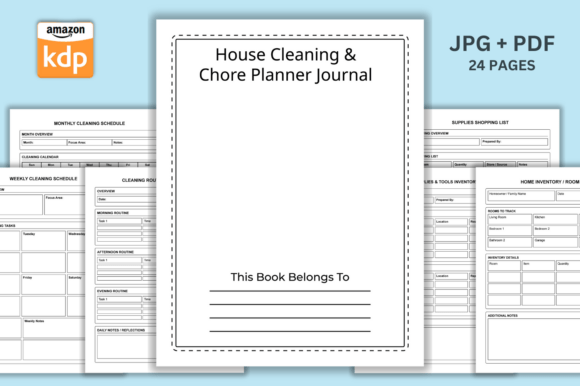
House Cleaning Chore Planner Journal
Keeping a home clean shouldn’t feel like managing a rotating shift at a five-star hotel—yet for many professionals, creators, and busy households, it often does. The House Cleaning Chore Planner Journal bridges that gap between intention and execution. It’s not just another printable—it’s a thoughtfully structured system designed to reduce decision fatigue, eliminate guesswork, and turn cleaning from a reactive chore into a predictable, even satisfying, part of your rhythm.
A Tool Built for Real Life—Not Just Aesthetic Pins
This 24-page interior journal (8.5″ × 11″, no bleed, 300 dpi) is engineered for practicality first. Every page serves a functional purpose—not filler. Whether you're a solopreneur juggling client calls and laundry, an educator resetting their space after remote teaching, or a small business owner managing a home office *and* family life, the layout supports clarity over clutter.
The high-resolution JPG and PDF files are KDP-tested and ready to upload—no resizing, no margins to fix, no last-minute formatting surprises. That means less time troubleshooting and more time using it. And because it’s fully customizable—cover pages, blank note sections, editable goal-setting spreads—you’re not locked into someone else’s idea of “productivity.” You shape it to fit how *you* think, plan, and live.
What Makes This Planner Stand Out?
Unlike generic checklists or overly rigid calendars, the House Cleaning Chore Planner Journal layers intentionality with flexibility:
- Yearly Goals + Room Inventory help you align cleaning habits with long-term vision—not just “clean the bathroom,” but “create a low-stress morning routine by streamlining bathroom surfaces.”
- Cleaning Supplies Inventory + Shopping List prevent duplicate purchases and last-minute store runs—especially valuable for freelancers budgeting supplies across multiple workspaces or rental properties.
- Daily/Weekly/Monthly/Seasonal Schedules let you scale effort based on bandwidth: a 15-minute daily reset, a focused Saturday deep-clean, or quarterly decluttering tied to seasonal shifts.
- Room-specific Checklists (bathroom, kitchen, bedrooms) include realistic, actionable steps—not vague prompts like “tidy up.” Think “wipe faucet aerators,” “vacuum under furniture legs,” or “check expiration dates in medicine cabinet.”
- Deep Cleaning Tracker + Last-Cleaned Log remove the mental load of remembering when you last cleaned the oven or washed baseboards—critical for landlords, Airbnb hosts, or anyone maintaining shared or rental spaces.
- Habit Tracker + Monthly Reflection Pages support behavior change, not just task completion. You’ll notice patterns—what sticks, what stalls, what needs adjusting—without needing a separate habit app.
More Than Just Cleaning: Cross-Use Value
Professionals use this journal beyond household management. Educators adapt the “Home Inventory” page as a classroom supply log. Bloggers and content creators repurpose the “Budget for Cleaning Expenses” spread to track prop, lighting, or set-up costs for photo shoots. Freelance organizers and virtual assistants use the Master Checklist and Room Logs as client-facing templates—customized, branded, and professional.
For digital creators launching printables, this file serves as both inspiration and infrastructure: it’s proof that structure doesn’t have to mean rigidity. The blank note pages (five included) aren’t afterthoughts—they’re intentional space for brainstorming, client notes, or adapting workflows mid-quarter. Even the “Challenges & Motivation” section doubles as a micro-journaling prompt for burnout recovery or energy mapping.
Practical Considerations Before You Print or Publish
If you're evaluating this for personal use: test the weekly schedule against your actual calendar—not idealized time, but real time. Notice where friction lives (e.g., “laundry day” scheduled on a day you teach back-to-back). Use the blank pages to annotate adjustments. That’s where the planner earns its keep—not in perfection, but in iteration.
If you're a publisher or creator planning to resell or bundle: the 100% KDP-tested format saves hours. But don’t skip reviewing the “Custom Task Page” and “Budget Log”—these are high-engagement spots readers often personalize and return to. Consider adding subtle branding cues (a discreet logo spot on the cover, consistent accent color in headers) without compromising usability.
And if you're using this alongside digital tools? Keep it analog *on purpose*. The tactile act of checking off a box, circling a date, or jotting “replaced air filter” in the tracker builds stronger neural pathways than tapping a screen. Pair it with your calendar app—but let the journal hold the *context*, not just the reminder.
Who Benefits Most—and Why
This isn’t for people who already have cleaning down to a science. It’s for those who’ve tried apps, sticky notes, voice memos—and still end up scrubbing grout at midnight before guests arrive. It’s for:
- Remote workers balancing workspace hygiene with home life—using the “Daily Schedule” to separate “work mode” from “home mode” through micro-cleans.
- Small business owners managing home offices, inventory storage, or client meeting spaces—leveraging the “Supplies Inventory” to avoid $40 emergency trips for paper towels.
- Content creators documenting cleaning routines for YouTube or Instagram—using the “Monthly Reflection” to identify what resonates with audiences versus what feels performative.
- Educators and caregivers establishing predictable rhythms for children or aging parents—where consistency matters more than speed.
- Landlords and property managers standardizing maintenance logs across units—turning the “When Did I Last Clean?” tracker into auditable documentation.
Final Thought: Clarity Over Completion
The real power of the House Cleaning Chore Planner Journal isn’t in finishing every checklist. It’s in reducing the cognitive tax of deciding *what* to do, *when*, and *why*. When your energy is finite—and it is—the value isn’t in doing more. It’s in knowing exactly where to invest less, so you can protect what matters most: your time, your calm, and your capacity to show up fully elsewhere.
That’s not housekeeping advice. It’s workflow design—with a mop bucket.